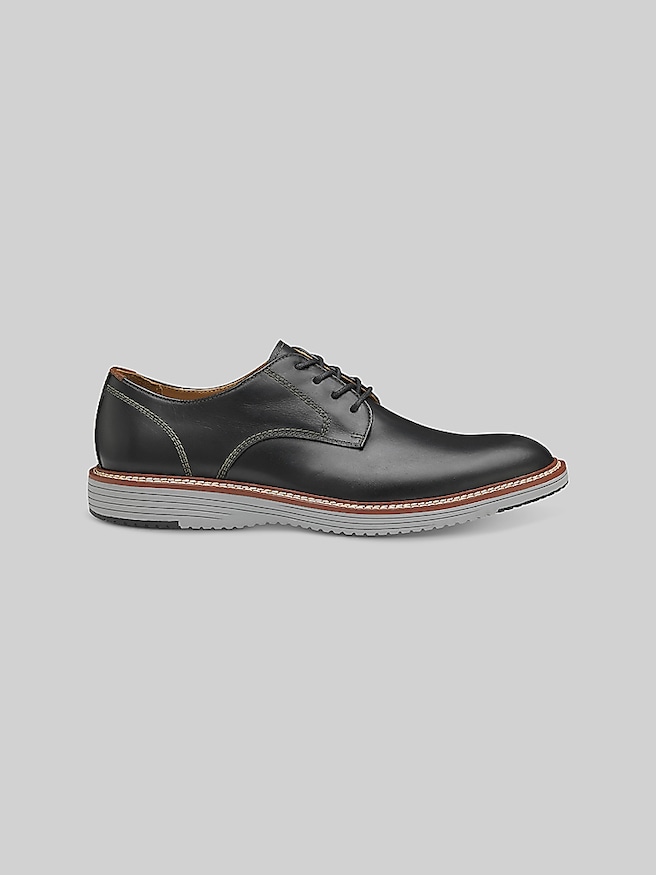
Men’s black work shoes bring together a professional appearance, a secure fit, and construction suited to the demands of the job. The category spans polished oxfords and loafers for business settings, flexible lace-ups for active office days, and specialized footwear for workplaces with defined safety requirements. The right choice depends on the dress code, the amount of time spent standing or walking, and the surfaces underfoot. In a traditional office, smooth black leather shoes create a clean foundation for a charcoal suit, navy dress pants, or a tailored sport coat. An oxford’s closed lacing gives the upper a neat, streamlined appearance, making it a natural companion to more formal tailoring. A derby has open lacing that generally allows more adjustment across the instep, while a simple loafer offers an uncluttered look with dress trousers or chinos when the workplace permits slip-on footwear. Details such as a rounded toe, understated stitching, and a low-profile sole help black shoes move comfortably between client meetings, presentations, and everyday desk work without competing with the rest of an outfit. More pronounced tread, contrast stitching, or a thicker sole gives a shoe a less formal character, which may fit a business-casual environment better than a conservative boardroom. Black is especially useful because it provides visual consistency: a matching black belt and well-kept shoes can make even a straightforward shirt-and-trouser combination look considered. Pant length matters, too. A hem that rests lightly over the upper lets the shoe’s shape remain visible, while excessive fabric pooling can obscure a clean silhouette. For someone moving between a reception desk, conference rooms, and an evening professional event, an understated design can serve several purposes without requiring a change of footwear. The strongest match is not necessarily the dressiest option; it is the style that looks appropriate, fits securely, and supports the actual rhythm of the workday.
Materials and construction influence how men’s black work shoes feel at the first fitting and how they hold up with repeated wear. Leather uppers can develop a softer, more individual fit over time, though the feel varies with the leather’s thickness, finish, and lining. Smooth leather is often practical for polished business dressing because surface dust and light marks can usually be addressed with appropriate cleaning and conditioning. Suede has a softer, more textured appearance and requires its own brush and care products, while synthetic uppers vary widely in flexibility, breathability, and maintenance needs. Inside the shoe, a smooth lining, a stable heel area, and cushioning beneath the foot can make a noticeable difference during long stretches away from a desk. Cushioning and support are related but distinct: a soft footbed may feel pleasant immediately, while a supportive shape helps distribute pressure and hold the foot more securely. For days divided between standing conversations and walking across a large workplace, Supportive Black Work Shoes offer a useful focus for comparing fit and underfoot features. A proper fit leaves room for the toes to move without letting the foot slide forward, and the widest part of the foot should align with the widest part of the shoe. The heel should feel held rather than pinched, with no persistent rubbing along the collar. Trying shoes with the socks intended for work gives a more accurate sense of interior space, particularly when a preferred insole or prescribed orthotic will also be worn. Shoes should not require painful breaking in to become wearable. Outsole construction deserves equal attention: rubber can provide flexibility and grip, while leather soles have a traditional dress appearance and a distinct feel underfoot. Neither material alone establishes slip resistance. When an employer requires slip-resistant footwear, a protective toe, or another safety feature, the stated specifications and applicable standards matter more than the shoe’s appearance. A black dress shoe should never be assumed to meet requirements intended for industrial or other higher-risk settings.
Durability is best understood as a combination of suitable construction, appropriate use, and consistent care rather than a single material or visual detail. A neatly finished seam, a secure connection between the upper and sole, and reinforcement around areas that flex repeatedly can all influence long-term wear. Some stitched constructions allow professional resoling, although repairability depends on the individual shoe and its condition. Flexible cemented construction can offer a lighter feel, but replacing the sole may be less practical. For daily office wear, alternating pairs when possible allows the interior to dry fully between uses and reduces the repeated stress placed on one pair. A shoehorn helps protect the heel counter from being crushed during dressing, and appropriately sized shoe trees can help leather shoes retain their shape between workdays. Routine care does not need to be elaborate: remove loose dirt with a soft brush or cloth, use cleaners appropriate to the upper material, and apply leather conditioner sparingly according to the care directions. Black polish can refresh color and improve the finish on suitable smooth leather, but suede and many synthetic materials need a different approach. Cleaning the outsole and checking for worn tread, loose stitching, or an uneven heel can also reveal when professional attention or replacement is needed. These details matter for a commuter walking several blocks, a manager circulating across an office, or a host spending much of a shift on foot. Black work shoes can also be a practical gift for a graduate beginning a first professional role or someone preparing for a new position, provided sizing preferences, workplace requirements, and personal style are understood. A familiar silhouette and an accurate fit are more valuable than an unfamiliar shape chosen only for appearance. Whether paired with a full suit or a more relaxed office wardrobe, well-chosen black work shoes provide a grounded, polished finish that remains useful across interviews, regular shifts, and important meetings.