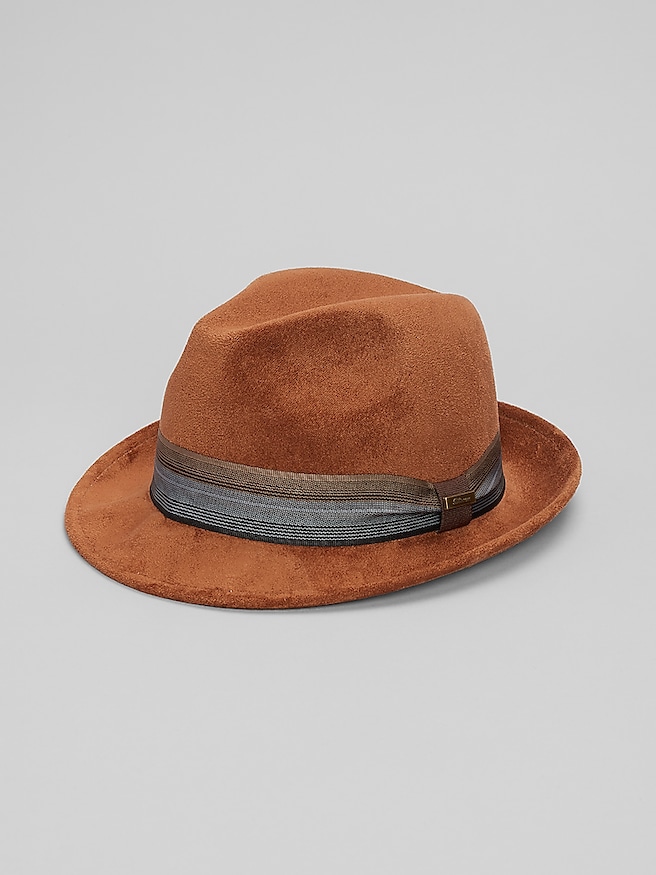
Brown hats are versatile accessories that range from relaxed baseball caps and knit beanies to flat caps, bucket hats, fedoras, and Western-inspired shapes. Their defining feature is an earthy color palette, with shades such as tan, camel, tobacco, chestnut, and chocolate offering distinct ways to finish an outfit. A light tan hat can add contrast to dark denim, while a deeper brown creates a quieter transition alongside charcoal trousers or a navy jacket. The shade matters, but so do the crown, brim, and texture: a softly rounded cap feels understated, a pinched felt crown adds definition, and a wider brim gives an outfit a more pronounced silhouette. These differences make men's brown hats useful across a range of settings, from a coffee stop in jeans and a casual shirt to an evening gathering with tailored separates. Brown also works comfortably with cream, olive, burgundy, and muted blue, making it easy to repeat without building every outfit around the accessory. Matching a hat precisely to shoes or a belt is not necessary; related tones usually look more natural than an exact color match across every piece. A chestnut hat with dark brown footwear, for example, can bring an outfit together while leaving room for variation. Texture provides another point of connection. A brushed felt hat complements the depth of a tweed jacket, while a cotton cap sits easily with denim and an unstructured overshirt. For coordinating layers, pairing brown hats with brown jackets creates a tonal foundation that can be balanced with a lighter shirt or darker pants. A restrained hatband or simple stitching keeps the emphasis on shape and color, while a contrasting band adds a more noticeable finishing detail. The most convincing combination is usually one that reflects the wearer's everyday style rather than making the hat feel like a separate costume. Someone who favors clean lines may prefer a compact brim; someone comfortable with expressive accessories may enjoy a broader shape with a distinctive crown.
Material and construction influence how a brown hat feels, holds its shape, and responds to regular use. Wool felt has a dense, matte surface and can support a defined crown and brim, although firmness varies with the felt and construction. Cotton twill is commonly used for casual caps because its woven texture suits straightforward, everyday wear. Knit fabrics provide stretch and a close-fitting profile, with fiber content affecting softness, recovery, and care requirements. Leather brings a smooth or textured surface that can develop character through use, while suede has a soft nap that gives brown shades added depth. Straw and other woven fibers create visible pattern and structure; their flexibility depends on the weave and finishing, so a structured woven hat should not automatically be treated as crushable. Small details are worth noticing because they affect comfort as much as appearance. An interior sweatband creates a buffer between the head and the hat, a lining changes the feel inside the crown, and an adjustable closure allows some caps to accommodate a range of measurements. A comfortable fit rests securely without leaving a tight pressure line across the forehead or pressing against the temples. For sized hats, head circumference and the maker's sizing chart are more useful than assuming the same size will work across every shape. Crown depth also matters: a shallow cap sits differently from a deeper one, even when both share the same stated measurement. Brim width changes the overall proportion, especially when a hat is worn with a jacket that has substantial shoulders or broad lapels. Durability comes from the whole construction, not simply a sturdy-looking exterior. Even stitching, a neatly attached band, a consistent weave, and a brim that returns to its intended shape are useful signs of careful workmanship. For commuting or frequent travel, packability should be an explicit feature rather than an assumption. A soft cap may fit into a bag easily, but a structured felt hat often needs protected space to preserve its profile.
Care helps brown hats retain both their color and their shape, and the right routine depends on the material rather than the shade alone. The care label is the starting point, particularly for blended fabrics, lined styles, and hats with decorative bands. Cotton caps are not automatically machine washable, and a firm brim or internal structure may need gentler handling than the outer fabric suggests. Felt generally benefits from light surface brushing with a suitable soft brush, while suede requires tools intended for its raised nap. Leather care should follow the manufacturer's recommendations, since an unsuitable cleaner or conditioner can alter the finish or darken the color unevenly. Spot treatment is best tested in an inconspicuous area before it reaches a visible part of the crown. If a hat becomes damp during cleaning, letting it dry naturally away from direct heat helps protect its shape and components. Storage matters just as much: a structured hat should be supported without pressure that bends the brim or dents the crown, rather than pushed beneath other accessories in a crowded drawer. Handling it by the brim instead of repeatedly pinching the crown can also reduce distortion on styles with a defined crease. These habits are especially useful for a hat worn often enough to become a familiar part of an outfit. A brown cap can accompany errands, casual lunches, and travel days, while a shaped felt hat may be a thoughtful finishing piece for dinners, celebrations, or occasions that call for more polished clothing. Brown hats can also make personal gifts for a father, brother, partner, or friend when the choice reflects how that person actually dresses. Adjustable styles offer some flexibility, while sized hats benefit from knowing the recipient's measurements. Someone who regularly wears denim and simple shirts may appreciate a low-profile cap more than a dramatic brim; a recipient who enjoys tailoring may favor a structured shape with a subtle band. A considered gift balances appearance with comfort, practical care, and a style the recipient can picture wearing repeatedly.