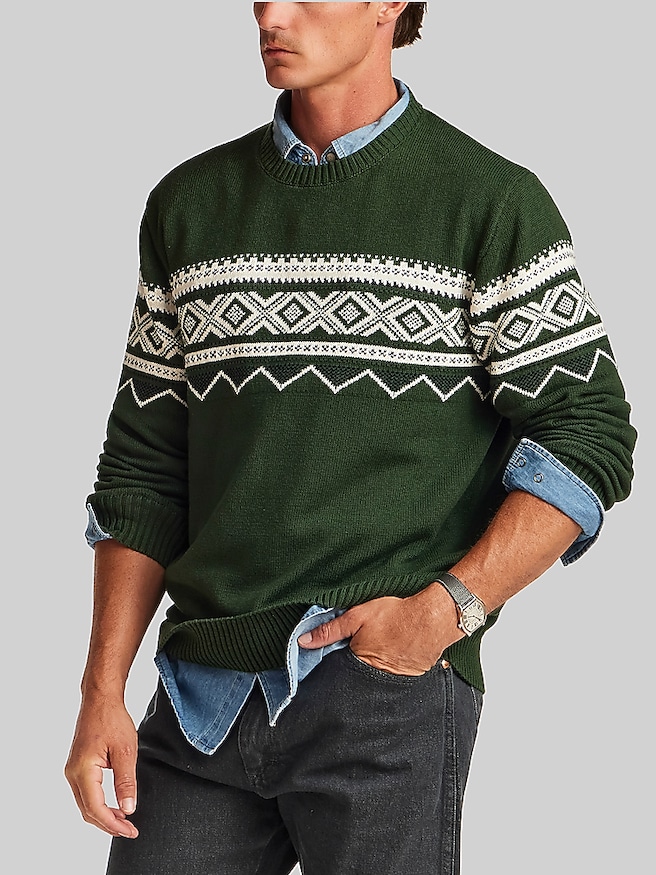
Men's Fair Isle sweaters are patterned knit sweaters known for repeating geometric motifs, contrasting colors, and horizontal bands of design. The name comes from Fair Isle, a small island in Scotland's Shetland Islands, where stranded colorwork developed into a distinctive knitting tradition. Traditional Fair Isle knitting generally uses two colors within a row, carrying the unused yarn across the back of the fabric to create small repeating shapes on the front. Contemporary interpretations draw on that heritage with patterns ranging from narrow bands of diamonds and crosses to more prominent arrangements across the chest and shoulders. Some designs keep the detail concentrated near the neckline, while others repeat it throughout the body and sleeves. That balance of pattern, color, and texture gives a Fair Isle sweater its character: visually interesting without requiring much else to complete an outfit. Fabric makes a meaningful difference in how the sweater feels and functions. Wool provides insulation and resilience, while lambswool often has a soft, lightly fuzzy surface that gives the pattern a gentler outline. Merino wool generally uses finer fibers, which can feel smoother against the skin, although individual sensitivity still matters. Cotton has a familiar hand and tends to produce a less springy knit, making its weight and construction important considerations. Blended yarns can combine the qualities of several fibers, influencing softness, shape retention, and ease of care. Fiber content alone does not determine warmth or durability; yarn thickness, stitch density, and the overall construction matter, too. A tightly knitted sweater may feel more substantial than a loosely knitted one of similar weight. Stranded sections can also create a denser fabric because more than one strand travels through the patterned area. For someone who likes heritage-inspired clothing, this combination of practical knitwear and intricate surface detail makes Fair Isle especially appealing. It brings personality to familiar wardrobe pieces without depending on a logo or an oversized graphic.
The best fit for a men's Fair Isle sweater leaves enough room for its intended layers without letting the patterned fabric bunch or pull. When a sweater will usually go over a T-shirt, a closer fit can create a neat outline; wearing it over a button-down generally calls for a little more space through the chest, upper arms, and shoulders. On a set-in sleeve, the shoulder seam should sit close to the natural shoulder rather than dropping far down the arm, unless the sweater is deliberately designed with a relaxed silhouette. Raglan sleeves and circular yokes have different seam arrangements, so comfort and freedom of movement are more useful checks than seam placement alone. Raising the arms, reaching forward, and sitting down can reveal tightness that is not obvious while standing still. The hem should fall comfortably around the waistband and upper hip without riding up, and the cuffs should stay near the wrists without covering the hands. Pattern placement also changes the overall effect. A band across the upper chest draws attention toward the shoulders, while smaller repeats spread the detail more evenly. Muted navy, gray, brown, and cream combinations are easy to coordinate with established wardrobe colors; stronger contrasts make the sweater a more noticeable focal point. Dark jeans and leather boots give the knit a straightforward casual setting for a neighborhood dinner or a weekend visit with friends. Chinos and suede shoes create a slightly more polished combination, while wool trousers can make a restrained pattern feel appropriate for an office with a relaxed dress code. A solid shirt beneath the sweater keeps the neckline crisp without competing with the design. When adding a jacket, a smooth lining and enough room through the sleeves help prevent the knit from catching or bunching. Within the broader Men Sweaters category, Fair Isle stands apart through its colorwork rather than one prescribed neckline, fabric weight, or silhouette.
A well-made Fair Isle sweater should feel comfortable in motion and look balanced when laid flat, with even stitching and ribbed edges that recover gently after stretching. On the inside, the carried strands, often called floats, need enough slack to let the fabric stretch without drawing the pattern inward. Excessively tight floats can cause puckering, while long, loose strands may catch on fingers or jewelry. These details are particularly useful to consider for a sweater that will be worn regularly rather than saved for occasional outings. Surface fuzz and pilling can develop through friction, especially beneath the arms or where a bag rubs against the body; they do not automatically indicate poor quality. Gentle maintenance helps preserve the appearance of the yarn and the clarity of the pattern. The care label should always determine whether washing, professional cleaning, or another method is appropriate, since fibers, dyes, and finishes respond differently to moisture and agitation. When hand washing is permitted, gentle handling is preferable to rubbing or wringing. A wet knit can become heavy, so supporting it during lifting and reshaping it flat to dry helps protect its proportions. Hanging can stretch the shoulders and lengthen the body, making folded storage a better choice for many sweaters. Clean, dry storage is especially important for wool, along with periodic checks for signs of moth damage. Between cleanings, airing the sweater and wearing a light layer underneath can help keep it fresh without unnecessary washing. For gifting, familiar colors, the recipient's usual sweater measurements, and a comfortable neckline are often more useful than choosing the boldest pattern. A father who favors chinos, a brother who lives in denim, or a partner who appreciates textured clothing may each wear the same style differently. The strongest choice reflects those everyday habits: a sweater with enough visual detail to feel distinctive, enough comfort for repeated wear, and care requirements that fit naturally into the recipient's routine.