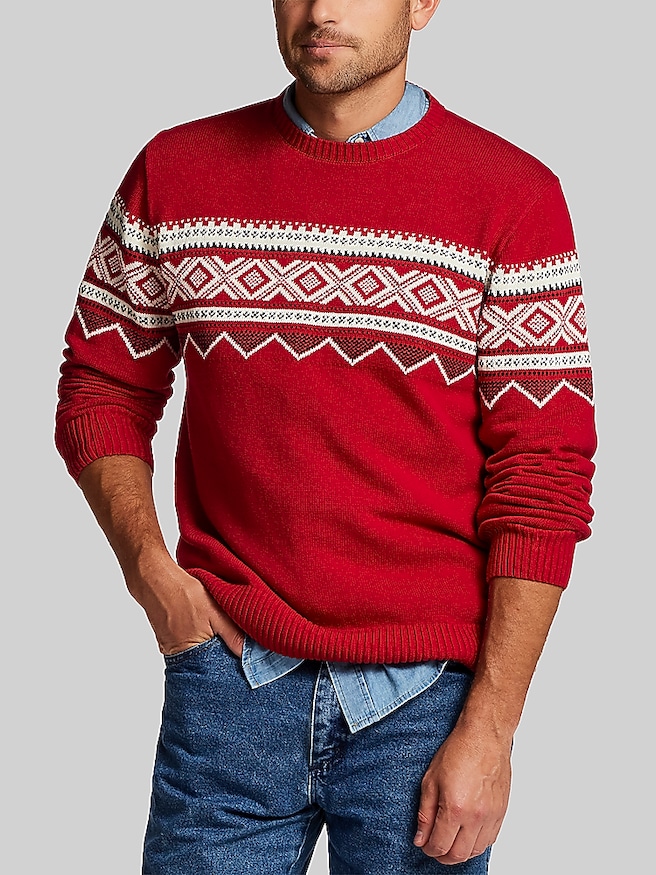
Men's Nordic and Fair Isle sweaters bring distinctive pattern and texture to everyday knitwear, with roots in practical clothing made for warmth. Although the names often appear together, they refer to related but different design traditions. Nordic sweaters draw broadly on Scandinavian knitting, often featuring bold geometric shapes, snowflake-inspired motifs, stars, or contrasting bands across the chest and shoulders. Fair Isle takes its name from the Scottish island in Shetland and is associated with stranded colorwork arranged in repeating horizontal bands. Traditional Fair Isle knitting typically uses two colors within a row, even when the complete design includes a broader palette. Both traditions can create richly patterned fabric without relying on large graphics or decorative trim. Stranded knitting carries unused yarn behind the stitches, adding another layer of yarn to the fabric; the warmth and weight still depend on the fiber, gauge, and construction. A circular patterned yoke draws attention toward the shoulders, while narrow repeating bands distribute color more evenly across the body. Neither layout belongs exclusively to one tradition, and contemporary interpretations frequently borrow from both. Navy, charcoal, cream, and earthy brown give these patterns a grounded appearance, while burgundy, forest green, or brighter accents add contrast. Pattern scale changes the effect as much as color does: small motifs can look subtle from across a room, while broad, high-contrast shapes make the sweater the clear focal point. With dark denim and leather boots, either approach feels relaxed and substantial. With chinos and an Oxford shirt, the same knit can look considered enough for a casual office or dinner with friends. Keeping the surrounding clothing mostly solid allows the colorwork to remain visible without making the outfit feel crowded. A useful starting point is to repeat one understated color from the sweater in the pants or shirt, rather than trying to match every shade in the pattern.
Material and fit determine how a Nordic or Fair Isle sweater feels through a full day of wear. Wool offers natural insulation and can absorb moisture vapor, making it a practical choice for cold-weather knitwear. Finer wool fibers, including merino, often feel smoother against the skin, although comfort varies with the yarn and the wearer's sensitivity. More textured wool can have a pleasantly substantial hand that suits traditional patterns, particularly when worn over a soft T-shirt or collared shirt. Cashmere and cashmere blends can contribute softness and warmth without necessarily adding much weight, while cotton generally provides a less insulating alternative with a familiar feel. Cotton-rich knits may suit someone who prefers less warmth indoors, though a thick cotton sweater can still be heavy. Synthetic fibers in a blend may contribute resilience or help a garment maintain its shape; the complete fiber mix and construction matter more than any single ingredient. Dense knitting, even stitches, and neatly finished seams are useful details to consider, but thickness alone does not establish quality or durability. The fit should leave enough room for the intended base layer without pulling the patterned fabric out of shape. On a set-in sleeve, a shoulder seam close to the natural shoulder usually creates a tidy outline, while dropped shoulders and circular yokes produce a different, intentionally relaxed shape. Colorwork should lie smoothly across the chest and upper arms rather than stretch tightly when reaching forward. A ribbed hem that rests comfortably near the hips helps the sweater sit neatly over pants, and cuffs should stay in place without digging into the wrists. Crewnecks frame a shirt collar cleanly, cardigans make it easier to adjust layers, and zip-neck styles offer another way to vary coverage. Anyone planning to wear a sweater beneath a coat should also account for sleeve bulk and room through the shoulders.
The appeal of Nordic and Fair Isle knitwear extends beyond its traditional origins. A restrained pattern can give a straightforward outfit more character for a relaxed workday, while a bolder yoke feels at home at a winter gathering, a cabin weekend, or a family dinner. For travel, a medium-weight knit that fits comfortably beneath an outer layer can be more versatile than an especially bulky sweater, particularly when moving between outdoor walks and heated rooms. These patterns also fit naturally among Modern Men's Sweaters, where clean proportions and a limited color palette can make heritage-inspired knitwear feel contemporary. For gifting, the recipient's usual clothing offers better clues than the boldness of the pattern alone. Someone who regularly wears navy jackets and gray pants may appreciate a similarly grounded combination, while a person drawn to expressive accessories might enjoy stronger contrasts. Texture preferences deserve equal attention: a soft hand, a comfortable neckline, and enough room for a favorite shirt often matter more in daily wear than an intricate motif. Checking the measurements of a well-fitting sweater can make sizing more dependable than relying only on a familiar letter size. Long-term enjoyment also depends on care suited to the actual garment. The care label should determine whether washing, dry cleaning, or another method is appropriate; wool, cotton, and blended knits do not all tolerate the same treatment. When hand washing is permitted, gentle handling and the recommended water temperature help protect the fibers and shape. Avoid wringing, and dry washable knits flat rather than suspending their wet weight from a hanger. Folded storage helps prevent stretched shoulders, while clean, dry storage is especially important for animal-fiber garments. Friction at the underarms or sides can cause pilling, which does not automatically mean a sweater is poorly made. Careful removal with a suitable knitwear tool can tidy the surface. With thoughtful handling, a well-chosen patterned sweater can remain a dependable part of a cold-weather wardrobe for years.