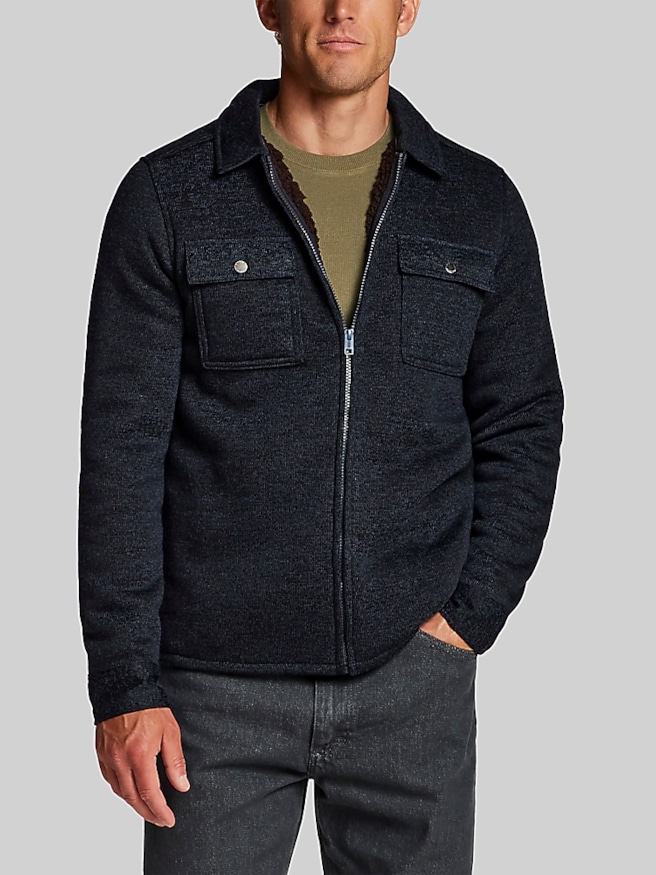
Men’s short winter jackets combine cold-weather insulation with a waist- or hip-length cut, offering warmth without the extra length of a full coat. That shorter shape makes everyday movement easier, whether the day involves driving to the office, walking to the train, or heading out for a casual dinner. A jacket that finishes near the hips can feel less cumbersome when sitting behind the wheel, while a waist-length silhouette creates a defined break between outerwear and pants. Length alone does not determine warmth: insulation, wind protection, collar construction, and room for layers all contribute to how a jacket feels outdoors. Short jackets also offer distinct proportions. A trim, lightly insulated shape sits neatly over a fine-gauge sweater, while a roomier quilted silhouette accommodates thicker knits without pulling across the shoulders. For shorter frames, a hem that does not extend too far down the thighs can help maintain balanced proportions, although the best length depends on torso measurements and personal preference rather than height alone. Bomber-inspired shapes bring a casual feel through ribbed cuffs and hems, while streamlined zip-front styles work naturally with chinos, dark denim, and leather boots. Wool-rich outerwear can provide a more tailored appearance for an office commute or an evening out. A short winter jacket is not always long enough to cover a suit jacket or sport coat, so the relationship between those two hems matters when dressing more formally. With casual layers, the same shorter cut can make an outfit feel clean and uncomplicated. Deep navy, charcoal, black, and earthy neutrals are easy to coordinate with everyday pants and sweaters, while texture adds interest without requiring bold color. The appeal is practical as much as visual: enough structure to finish an outfit, enough freedom to move comfortably, and a compact silhouette that transitions easily between a brief walk outside and time spent indoors. For someone who moves frequently between a vehicle, an office, and neighborhood stops, that balance can be especially useful.
Materials and construction give short winter jackets much of their character, and two jackets with similar shapes can perform quite differently. Wool and wool-blend fabrics offer texture, a substantial hand, and a polished appearance, with warmth influenced by fabric weight, weave, lining, and any added insulation. Nylon and polyester shells often lend themselves to lightweight quilted designs, while tightly woven fabrics help limit wind penetration. A water-resistant finish can shed light moisture, but it should not be confused with waterproof construction intended for sustained precipitation. Down insulation provides warmth with relatively little weight and compresses easily, though its performance can decline when it becomes wet. Synthetic insulation generally retains more insulating ability when damp and can be practical for everyday conditions involving light snow or intermittent moisture. Neither insulation type tells the whole story: fill quantity, construction, coverage, and the layers underneath also matter. Down fill power describes loft rather than serving as a complete warmth rating, so a higher number alone does not establish how warm a finished jacket will be. Linings affect comfort as well. Smooth linings help sleeves slide over shirts and sweaters, while brushed or fleece-like surfaces can add a cozy feel against lighter layers. For a related category centered on that interior construction, men’s lined winter jackets offer another way to explore cold-weather outerwear. Small details become noticeable in everyday wear: a collar that closes comfortably at the neck, cuffs that sit securely around the wrists, and a hem that limits drafts can make a shorter jacket feel more protective. A zipper backed by a storm flap helps reduce airflow through the front opening, while pockets with secure closures keep small essentials contained. Hoods add coverage when needed, although their presence alone does not establish weather protection. A short jacket is especially convenient for active commutes and frequent indoor stops; extended time outside in severe cold may call for greater coverage and more substantial insulation.
Fit determines whether those materials and details work comfortably together. A well-fitting short winter jacket allows the shoulders and upper back to move without the body looking excessively loose. With the front fastened over the layers normally worn underneath, the chest should feel comfortable rather than compressed, and the sleeves should not twist or bind when reaching forward. Sitting down provides another useful point of reference: a hem that rides up sharply or a front closure that strains can indicate that the cut is too close, too short, or poorly matched to the wearer’s proportions. At the same time, excess room around the torso can admit drafts and create bulk beneath the arms. The right balance leaves space for a sweater while preserving the jacket’s intended shape. Durability depends on more than fabric thickness. Even stitching, reinforced stress points, securely attached fasteners, and a zipper that operates smoothly all contribute to reliable everyday wear. Pocket edges and cuffs receive frequent friction, particularly when carrying a shoulder bag or commuting, so those areas deserve attention over time. Care requirements vary by shell fabric, insulation, and trim, making the sewn-in care label the most reliable starting point. Some jackets can be machine washed under specified conditions, while others require professional cleaning; wool-rich fabrics and mixed-material designs may need especially careful handling. Insulated jackets should be dried thoroughly according to their care instructions before storage, and down-filled styles may require a particular drying process to restore loft. A damp jacket benefits from being allowed to dry fully before going into a closet, away from direct heat that could damage fabric or finishes. Between wears, a suitable hanger helps maintain shape, while long-term storage is generally best kept dry and uncompressed. As a gift, a short winter jacket can be a thoughtful choice for someone who prefers easy movement and a versatile everyday silhouette. Familiar colors, the recipient’s usual layering habits, and accurate sizing make that choice more personal. The strongest match is a jacket suited to the wearer’s actual routine, from a brisk walk with a scarf to a commute spent mostly in the car.