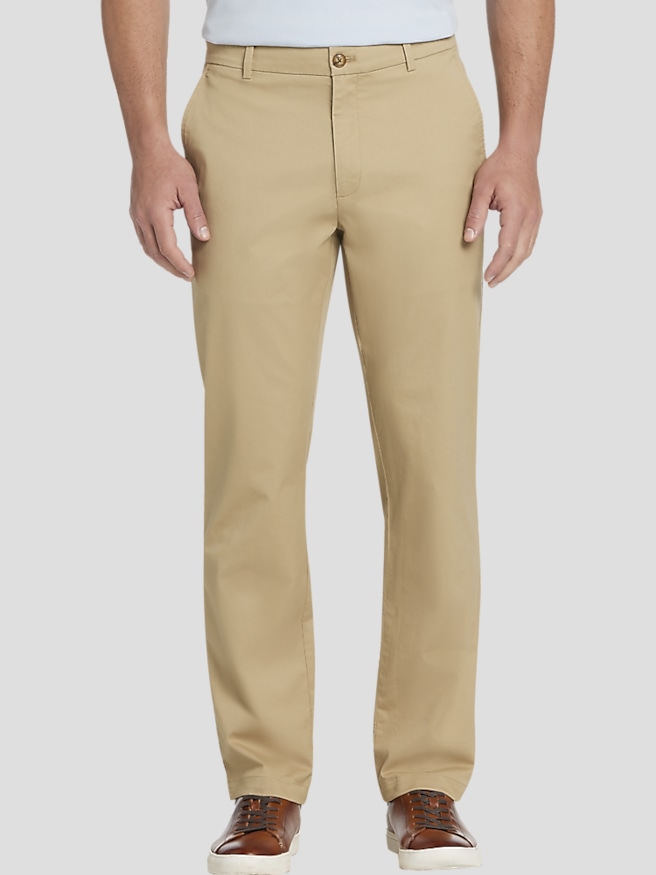
Men’s easy-care work outfits pair a professional look with fabrics that need less pressing or simpler laundering. Wrinkle-resistant dress shirts, stretch chinos, and machine-washable tailoring can all serve that purpose, but the right combination depends on the dress code and what the day involves. A smooth dress shirt and tailored trousers fit an office where a morning presentation might turn into lunch with a client, while an unstructured blazer adds a layer of polish without the stiffness of heavily constructed tailoring. In a business-casual setting, a knit polo with a collar that lies flat works with straight-leg or tapered chinos, and a fine-gauge crewneck can sit over a collared shirt without adding much bulk. Navy, charcoal, and khaki trousers give patterned shirts and solid knits an easy starting point. Leather lace-ups suit the more formal end of that range, while loafers or clean, understated sneakers can work where the dress code is more relaxed. For a related selection centered on lighter office layers, see Summer Office Wear. Beyond the office, a job that involves moving between a counter, a stockroom, and a sales floor puts more emphasis on freedom of movement and fabric that can stand up to friction. A work shirt with a little give through the shoulders and trousers with enough room to bend can feel noticeably better by the end of a long shift. On a business trip, fabrics that recover well from creasing are useful when a shirt spends hours folded in a carry-on or a pair of trousers goes straight from a flight to a meeting. Easy care means something a little distinct in each setting: fewer creases across the lap after sitting, a collar that looks neat without much attention, or a garment that can go back into regular rotation after a home wash.
Fabric content helps explain how an outfit will feel and hold up, though the weave, finish, and construction matter as much as the blend. Cotton-rich shirting can have the crisp feel of a traditional dress shirt, while a cotton-polyester blend often dries faster than comparable all-cotton fabric. A wrinkle-resistant finish can cut down on pressing around the placket and cuffs, but a shirt may still pick up folds after several hours under a jacket. Nylon blended with elastane can offer flexibility in trousers designed for frequent movement, and good stretch recovery helps the fabric return to shape after repeated sitting and bending. Moisture-wicking knits are useful for active shifts because they move moisture away from the skin; that feature alone does not tell much about how neatly a collar will hold its shape. Fine-gauge wool knits can layer smoothly under tailoring, but their care requirements vary, so fiber content alone is not a reliable sign that a sweater can go in the washing machine. Fit also changes how a fabric performs. A shirt with enough room across the upper back is less likely to pull at the buttons when reaching across a desk. A blazer sleeve should allow that same reach without dragging the whole jacket forward, and a trouser waistband should feel comfortable seated as well as standing. Stretch can make a trim cut easier to move in, but it will not make up for a rise that pinches or a thigh that pulls tight on the stairs. A straight leg offers more room from the knee down, while a taper narrows the opening without necessarily changing the fit at the seat or thigh. For clothes worn several times in a workweek, seams that lie flat and fabric that springs back after bending are useful signs to look for, especially around elbows, knees, and pocket openings.
The care label gives the clearest sense of how much upkeep a work outfit will take. Wrinkle resistance, machine washability, and permission to tumble dry are separate features. A blazer may be machine washable but need to dry flat, while trousers that can go in the dryer may call for low heat. Even when the outer fabric looks similar on two jackets, the lining and internal construction can call for separate care routines. When the label permits, washing in cold water and avoiding high dryer heat can help protect stretch fibers and limit fading. Promptly removing a shirt from the washer and smoothing the collar, cuffs, and front before hanging it can keep small folds from drying into sharper creases. A washable knit that calls for flat drying is less likely to stretch out at the shoulders when supported on a drying rack rather than hung up wet. For someone who wears the same few pairs of trousers on repeat, rotating them gives each pair a break from friction at the seat, inner thighs, and pocket edges. Emptying pockets before washing also keeps a set of keys from rubbing against the fabric through an entire cycle. The simplest routine is usually the one that fits an existing laundry load without extra steps, which makes the label worth checking even on familiar fabrics. Easy-care work clothing can also be a practical gift for someone starting a job, returning to an office, or taking on more travel. A washable shirt in a familiar fit or a neutral knit that layers under a jacket is easier to choose when the recipient’s dress code is known. For daily wear or as a gift, the lasting value of an easy-care outfit is in the details that hold up to regular use: a collar that sits neatly, knees that recover after a long day at a desk, and a wash routine simple enough to repeat.