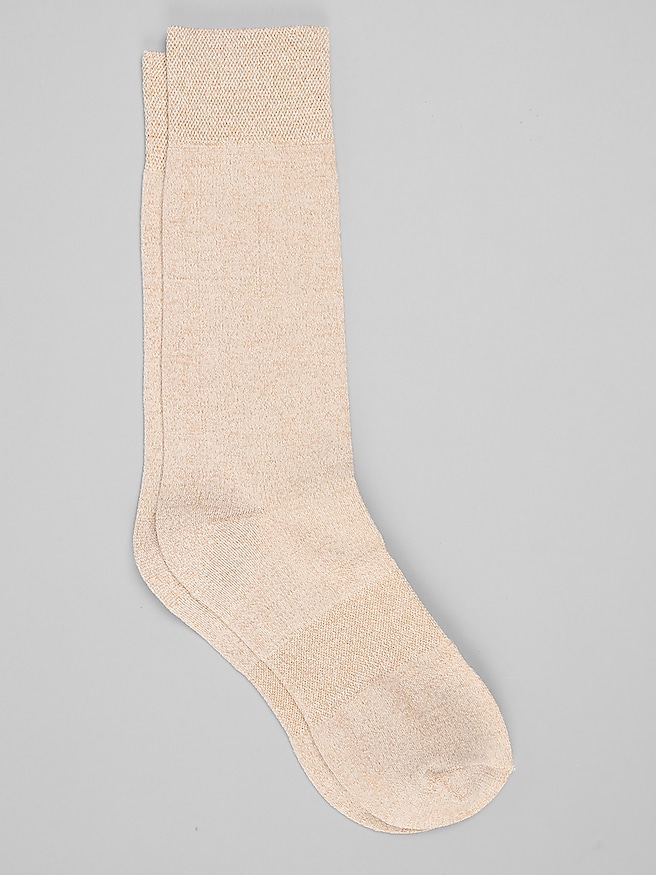
Lightweight socks provide a thin, low-bulk layer between the foot and the shoe, making them a practical choice for dress shoes, loafers, sneakers, and other footwear with a close fit. Their appeal comes from comfort without unnecessary thickness: a smooth knit can help a shoe sit as intended while keeping fabric from bunching beneath the toes or around the heel. Lightweight describes the weight and construction of the sock, not a single material or level of performance. Some pairs have very little cushioning throughout, while others combine a fine-knit upper with modest padding beneath the heel and forefoot. Breathability, moisture management, and drying time depend on the fibers and knitting technique rather than thinness alone. Cotton blends offer a familiar, soft feel for everyday wear, although cotton absorbs moisture and can take longer to dry than many synthetic fibers. Merino wool can absorb moisture vapor and help resist odor, with fine-gauge versions providing a less bulky feel than traditional thick wool socks. Polyester and nylon are often used to support moisture transport, drying, and resistance to abrasion, while small amounts of spandex help the fabric stretch and recover. Rayon made from bamboo can feel soft and smooth, but the finished blend and construction matter more than the source fiber alone. For someone moving between a commute, a desk, and an evening gathering, those details influence how comfortable a pair feels after several hours inside the same shoes. A smooth toe area may be especially welcome in a tapered dress shoe, while an airy knit across the top of the foot can complement sneakers worn for extended walking. Lightweight socks are also useful for people who prefer less padding underfoot or find that thicker hosiery crowds an otherwise well-fitting shoe. They should still provide enough coverage and stability for the intended activity; a thin everyday dress sock and a lightweight athletic sock may share a similar weight without serving the same purpose.
Fit is central to how lightweight socks feel throughout the day. A well-proportioned pair follows the shape of the foot, places the heel pocket where the heel actually rests, and leaves the toes comfortable rather than compressed. Excess length can create folds inside the shoe, while a sock stretched beyond its intended size may pull against the toes or allow the heel to slip out of position. The listed shoe-size range is a useful starting point, with foot width, instep height, and fabric stretch also affecting the result. Cuffs should hold their position without digging in, and a close fit should not be confused with medical compression. Ribbing or an elasticized band through the arch can help stabilize the fabric, but it does not replace the support built into footwear or prescribed inserts. Length changes both the appearance and the function of a sock. No-show styles sit below the shoe opening for an exposed-ankle look, though their coverage needs to match the shape of the shoe to avoid rubbing at an uncovered edge. Low-cut and ankle lengths suit many casual and athletic settings, while crew and over-the-calf lengths provide more coverage beneath trousers. For a business meeting or a formal gathering, a longer dress sock helps keep bare skin from showing when seated or crossing one leg over the other. Navy, charcoal, and black create a restrained foundation, especially when coordinated with trousers; subtle stripes, small geometric patterns, or a contrasting color can add interest without dominating an outfit. A fine-knit sock under tailored pants should lie smoothly through the ankle rather than gathering into a bulky ridge above the shoe. For workouts, repeated walking, or activities that involve more perspiration, Performance Socks offer a related category to consider, with attention to features such as moisture-wicking yarns, secure heel construction, ventilation zones, and targeted cushioning. Those features vary by construction, so lightweight does not automatically mean suited to running, hiking, or every kind of training.
The best lightweight socks for a particular wardrobe balance a comfortable feel with enough resilience for regular use. Thin fabric is not necessarily fragile, and thick fabric is not automatically more durable. Yarn quality, knit density, reinforcement, and fit all contribute to how well a sock holds up. The heel, ball of the foot, and toe area experience repeated friction, making reinforcement in those zones a useful detail for anyone who spends much of the day on foot. A smooth or low-profile toe seam can reduce an irritating ridge, particularly inside close-fitting shoes, although no sock can guarantee protection from blisters. Properly fitted footwear, a sock that stays in place, and attention to moisture all play a part. Care also affects comfort over time. The care label should determine washing and drying methods because wool blends, cotton blends, and synthetic knits may need distinct treatment. Turning socks inside out before washing can help expose the inner surface to cleaning, while a mesh laundry bag keeps small pairs together and limits snagging on zippers or hooks. Excessive dryer heat can shorten the life of elastic fibers or change the fit of some blends; air-drying or using a label-approved low-heat setting is often a gentler approach. Fabric softener may interfere with moisture-management finishes, so following the stated care directions matters for technical constructions. Regular rotation gives each pair time to be washed and fully dried, and checking for thinning heels, worn toes, or cuffs that no longer recover helps keep everyday comfort consistent. As a gift, lightweight socks can be a thoughtful addition to the wardrobe of a graduate preparing for office life, a frequent traveler who values compact essentials, or someone who enjoys coordinating the small details of an outfit. Shoe size, preferred sock height, and familiar colors make better starting points than assuming one style suits everyone. Whether worn with polished lace-ups for a presentation or casual sneakers for a day of errands, a well-chosen lightweight pair brings a quiet finishing touch: enough coverage to feel comfortable, a neat fit inside the shoe, and minimal bulk beneath the clothes.