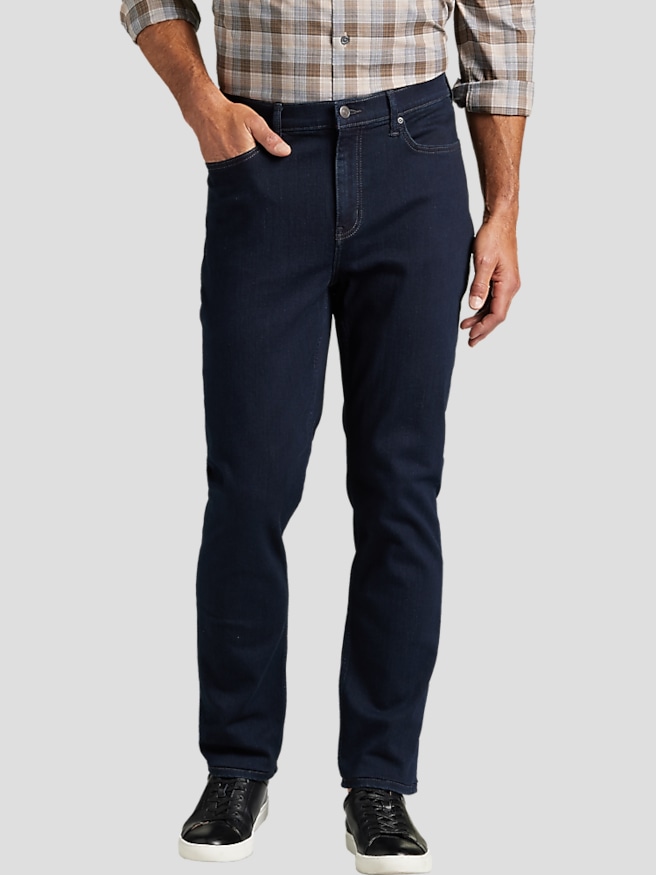
Fitted jeans for men follow the shape of the body without pinching at the waist, pulling across the seat, or binding at the knees. A fitted look doesn’t require a skinny cut. Slim-fit jeans sit close through the seat and thighs and usually finish with a narrow opening. Straight-fit jeans keep a more consistent width from knee to hem, giving the leg a clean line without hugging the calf. Athletic-fit jeans provide extra room through the seat and thighs and often taper below the knee, a useful combination for men who need thigh room but don’t want a loose waistband. Relaxed-fit jeans are roomier through the seat and thighs and generally have a fuller leg, though they can still fit neatly at the waist. Taper describes how much the leg narrows toward the ankle, so two pairs with similar room up top can look quite distinct over the same shoes. Rise is the distance from the crotch seam to the top of the waistband, and it affects where the jeans sit as well as how they feel when seated. A mid-rise pair may sit comfortably near the natural waist on one build and a little lower on another. More telling than the cut name is what happens during ordinary movement. Jeans can look good in a standing mirror but feel too snug the moment someone takes a seat at dinner or bends to tie a shoe. Deep pull lines across the lap, front pockets that flare open, and a waistband that digs in when seated are better clues to a poor fit than the number on the tag. At the other end of the leg, a hem that just meets the top of a sneaker keeps the silhouette clean, while a slight fold where the denim meets a boot leaves a little more length without a stack of fabric at the ankle. An opening that catches on the boot shaft can make the leg bunch even when the inseam is right, so the shoes a man wears most often are a good reference for both length and leg opening.
Fabric has as much to do with how fitted jeans feel as the shape of the leg. All-cotton denim typically starts out firmer and softens with wear, picking up creases where the body bends most often. Stretch denim usually blends cotton with a small amount of elastane, which gives the fabric some flexibility when climbing stairs, getting into a car, or sitting through a long commute. A close cut with a little stretch may feel easier at the knee than the same cut in rigid denim, but stretch is no substitute for enough room through the seat and thighs. Fabric weight makes a noticeable distinction, too. Heavier denim tends to feel more substantial and hold a crisp line, while lighter denim usually bends and drapes more easily. Weight alone doesn’t determine how long jeans will last. The inside thighs, pocket edges, and hems see repeated friction, and a cut that stays under tension at those points can wear unevenly. An inseam that keeps the back of the hem off the ground can spare the fabric from fraying under the heel. Care also affects how the fabric wears and how well it holds its color. The care label takes precedence, but turning jeans inside out and washing in cold water with like colors helps limit fading and dye transfer. Dark indigo denim can leave a trace of color on light upholstery or shoes, particularly before its first few washes. Air-drying, when the label allows it, avoids the high heat that can shrink cotton or shorten the life of stretch fibers. Denim doesn’t need laundering after every wear if it’s still clean, though a spill or visible dirt is a good reason to wash it rather than let the stain settle. Over time, cotton denim often develops softer folds behind the knees and lighter areas where hands brush the pockets. Those marks are part of how denim ages and can give two pairs in the same wash a distinct look.
The appeal of fitted denim is how easily it shifts from an everyday outfit to one that looks a little more put together. Dark indigo or black jeans with an even finish pair naturally with a tucked Oxford shirt and loafers for a casual dinner or a workplace where denim fits the dress code. A straight leg leaves enough room to fall over a boot, while a tidy taper keeps a low-profile sneaker from disappearing under the hem. Medium and light washes tend to look more casual, particularly when fading brings out the seams and creases. With a plain T-shirt and clean sneakers, that texture can be all the detail an outfit needs. Wash can also change the way the cut reads: strong fading across the thighs draws the eye there, while a more uniform finish lets the line from hip to hem stand out. Men who spend much of the day seated may put more emphasis on how the waistband and lap feel than on a particularly narrow ankle. Those who wear boots most days may favor an opening that slides over the shaft without catching. These preferences are helpful when choosing jeans as a gift, too. The waist and inseam on a well-worn pair are a starting point, but the cut, rise, and amount of stretch offer better clues to why that pair keeps getting worn. Measuring a favorite pair laid flat can also be more useful than relying on the tag alone, since the same labeled size can fit differently from one cut to another. The selection in Must Have Jeans For Men offers a broader look at everyday denim. For a fitted pair in particular, the best sign is often the simplest: the jeans look neat with the shoes already by the door and feel just as comfortable sitting down as they do standing in front of the mirror.