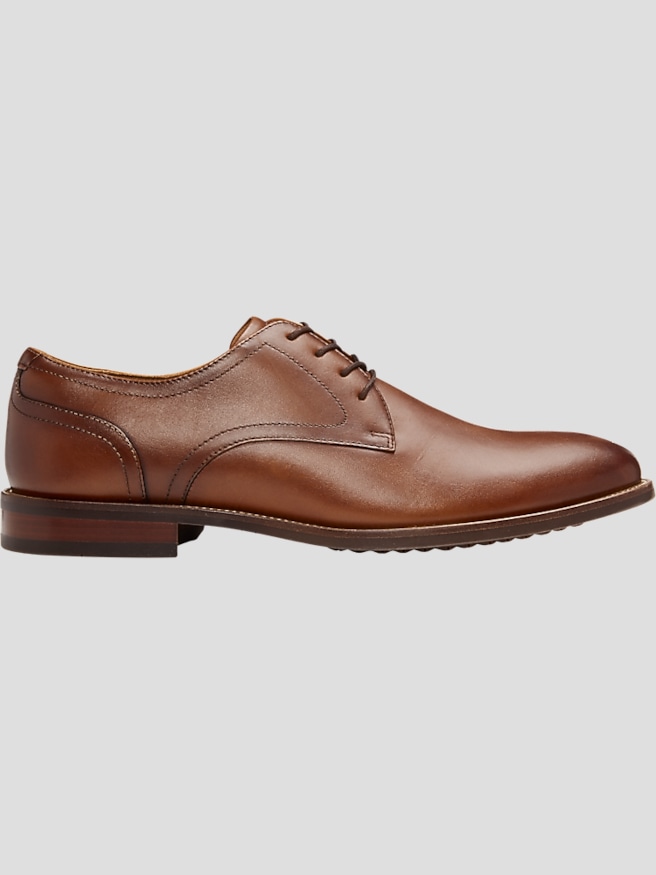
Brown oxford shoes for men bring a polished finish to tailoring without the stark contrast of black footwear. Their defining feature is closed lacing: the sections that hold the eyelets are stitched beneath the vamp, the front portion of the upper, creating a neat, close-fitting shape across the top of the foot. That construction distinguishes an oxford from a derby, which has open lacing and a slightly more relaxed appearance. Within the brown color family, shades range from light tan and warm cognac to deep chocolate, with each tone giving an outfit a distinct character. Dark brown tends to look understated with navy or charcoal tailoring, while lighter shades create a more noticeable contrast against blue and medium-gray trousers. A plain-toe oxford keeps the front of the shoe clean and uninterrupted. A cap-toe adds a seam across the toe, offering a familiar dress-shoe detail that works well for office presentations, interviews, and wedding guest attire. Wingtip designs extend that detail into a sweeping shape, often accompanied by broguing, the decorative perforations along seams and edges. Broguing describes the decoration rather than the lacing construction, so an oxford can be either simple or richly detailed. Smooth leather, a restrained toe shape, and a darker finish generally create the dressiest effect; pronounced perforations and textured surfaces feel less formal. With a navy suit, a chocolate-brown cap-toe provides a balanced foundation, while a cognac pair can give gray dress pants and a sport coat a more expressive finish. A brown belt in a similar depth of color helps the outfit feel cohesive without requiring an exact match. For a distinctive two-tone alternative, Brown and White Oxford Shoes introduce stronger contrast and a more eye-catching look. Brown oxfords suit many professional and celebratory settings, though traditional black-tie attire generally calls for black formal footwear rather than brown dress shoes.
Materials and construction influence how brown oxfords feel, how they age, and how much maintenance they need. Smooth leather is a familiar choice for dress shoes because it can take polish and develop subtle character with wear. Full-grain leather retains the outer grain surface, while corrected-grain leather has been treated to create a more uniform appearance; neither description alone establishes how comfortable a finished shoe will be. Leather quality, lining, sole construction, and fit all contribute to the experience. Suede offers a soft, matte texture that pairs naturally with chinos and less formal tailoring, but it needs care products intended for its nap rather than standard leather cream. Synthetic uppers have their own care requirements and generally do not respond to conditioning like leather. Inside the shoe, a smooth lining can reduce friction, while cushioning and arch support may make extended standing more comfortable. A leather sole gives a traditional profile and can feel firm initially; a rubber sole can provide additional grip and flexibility, depending on its design. Stitched constructions, including some welted designs, may allow a worn sole to be replaced, although repairability depends on the complete construction and a cobbler’s assessment. Fit deserves just as much attention as the material description. Closed lacing can feel snug over a high instep, and the right size should accommodate the top of the foot without pressure or excessive gaping around the eyelets. The heel should feel secure, the widest part of the foot should align comfortably with the shoe’s widest area, and the toes should have space without pressing against the front. A sleek or elongated toe can contain extra space beyond the toes by design, so appearance alone is not a reliable measure of fit. Trying shoes with the dress socks intended for everyday wear gives a more useful impression than trying them with thick athletic socks. For someone who uses orthotics, interior depth and a removable footbed can matter as much as the stated size. Leather may soften with wear, but persistent pinching, numbness, or cramped toes should not be treated as a normal break-in requirement.
Consistent care helps preserve the color, shape, and finish that make brown oxford shoes useful across a broad wardrobe. On smooth leather, removing surface dust with a soft brush or cloth before applying any treatment prevents grit from being worked into the upper. A suitable leather conditioner, used according to its directions, can help maintain suppleness; it is worth testing on an inconspicuous area because some formulas darken brown leather. Shoe cream in a compatible shade can refresh color and provide a modest sheen, while a small amount of wax polish can add shine to the toe and heel. Heavy wax buildup across flex points can leave an uneven finish, so a restrained application usually looks cleaner. Suede needs a separate routine built around a suede brush and an appropriate cleaner, with gentle brushing helping lift the nap rather than flatten it. Any protective treatment should be compatible with the material and tested first. If shoes become damp, allowing them to dry naturally away from direct heat helps avoid damage to the leather and adhesives. Shoe trees support the shape between wears, and rotating footwear gives the interior time to dry. Checking heels and soles for uneven wear can also catch a repair need before it affects balance or comfort. That attention is worthwhile for a pair used repeatedly for client meetings, dinner reservations, or occasions that involve both seated time and standing. Brown oxfords can also make a thoughtful gift for a graduate beginning a professional role, a partner who enjoys tailored clothing, or someone preparing for an important celebration. Knowing the recipient’s size, width, preferred toe shape, and usual dress code makes the choice more personal and practical. A deep-brown, minimally detailed style fits naturally into a suit-focused wardrobe, while a lighter or brogued design complements sport coats and chinos. The strongest choice balances the desired appearance with a comfortable fit, suitable construction, and a care routine that fits everyday life.