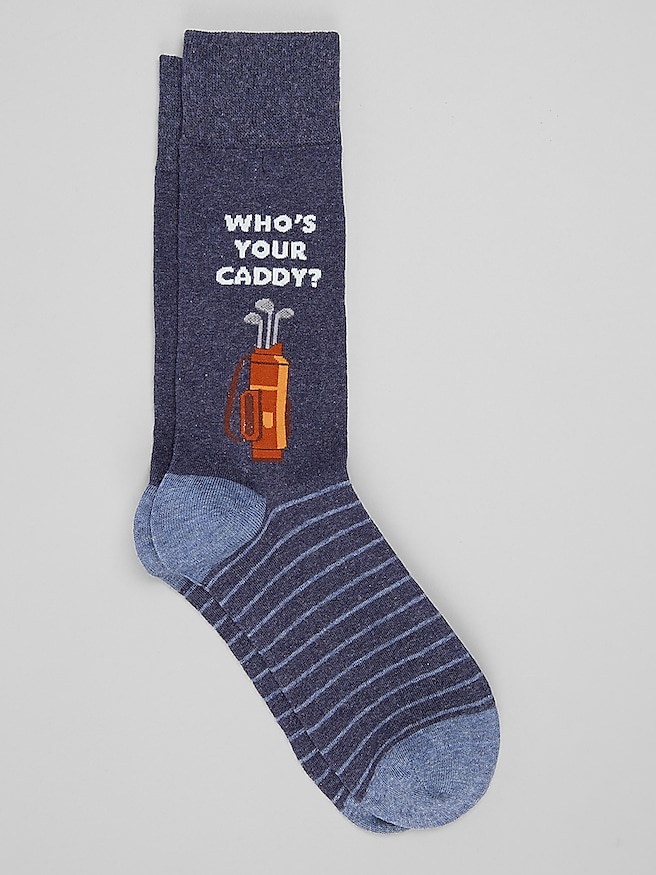
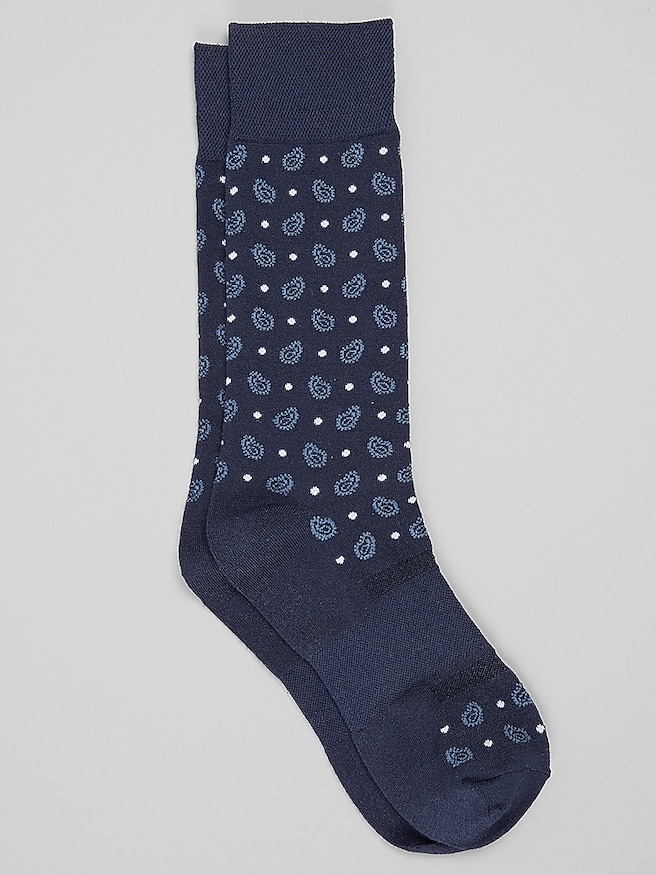
Novelty cotton socks bring playful patterns, unexpected color, and a little personality to an everyday essential. Their defining feature is the design: illustrations, geometric repeats, hobby-inspired motifs, or humorous details that distinguish them from solid dress socks. Cotton contributes a familiar, soft feel, while the overall comfort depends on the fiber blend, knit, thickness, and fit. That combination makes these socks an easy way to express an interest without building an entire outfit around it. A small food motif can be a nod to an enthusiastic home cook, while animal patterns or music-inspired graphics can reflect something meaningful to the wearer. Under tailored trousers, the design may appear only when someone sits down or crosses a leg; with cuffed chinos or jeans, it becomes a more visible part of the outfit. Both approaches work, and the scale of the pattern helps set the tone. Closely spaced, small illustrations tend to look more understated from a distance, while large graphics and high-contrast colors draw attention. For an office outfit, a pattern with a navy, gray, or burgundy background can connect naturally with familiar tailoring colors. For a relaxed dinner or a casual gathering, a brighter design can provide contrast against simple pants and clean-lined shoes. There is no need to repeat every color elsewhere in the outfit. Picking up one shade from a shirt, tie, or pocket square is usually enough to make the combination feel intentional rather than overly coordinated. Novelty socks can also add an individual touch to wedding attire, provided the pattern suits the dress code and the couple’s preferences. The strongest combinations leave enough visual space for the socks to be noticed without competing with several other bold accessories. Explore Men's Novelty Socks for another way to bring expressive details into everyday dressing, from subtle repeating motifs to more conspicuous graphics.
The word “cotton” describes part of a sock’s material story, not necessarily its entire composition. Novelty cotton socks may combine cotton with synthetic fibers that contribute stretch, shape retention, or resistance to wear. Cotton-rich fabric often feels soft against the skin, while a small amount of elastane can help a sock stretch over the heel and recover around the foot. Nylon or polyester may support durability, although performance depends on the proportions, yarn quality, and construction rather than the presence of any single fiber. Combed cotton has undergone an additional process to remove shorter fibers and align the remaining fibers, which can produce a smoother yarn. That distinction can matter to someone who notices fabric texture, but it does not replace checking fit and thickness. A fine knit generally takes up less space inside close-fitting dress shoes; a more cushioned knit may feel comfortable in roomier casual footwear. Too much fabric inside a snug shoe can create pressure, while a sock that is too loose can bunch beneath the toes or slide at the heel. Size ranges should correspond to the wearer’s shoe size, with the shaped heel sitting where it belongs rather than pulling under the arch or climbing above the back of the foot. Length matters, too. Crew socks provide visible space for a design, but the height needed to maintain coverage beneath trousers depends on the wearer’s proportions and the trouser hem. A cuff should feel secure without leaving the leg uncomfortably compressed. Toe seams and the inside of patterned areas deserve attention, particularly for people sensitive to raised stitching or loose yarn floats. Cotton absorbs moisture, but the complete blend and knit influence how a sock handles it; decorative everyday socks should not automatically be treated as athletic performance socks. For commuting, desk work, dinners, and ordinary errands, the most useful balance is a comfortable fabric, a stable fit, and a design the wearer will enjoy seeing again.
Thoughtful care helps preserve both the feel of novelty cotton socks and the definition of their patterns. The care label should take priority because cotton blends, dyes, and decorative details can have distinct requirements. When permitted by that label, washing inside out can reduce friction against the visible surface, and washing with similar colors helps limit unwanted color transfer. A gentle cycle and mild detergent are often appropriate for everyday knits, while excessive heat can contribute to shrinkage or affect stretch fibers. Air-drying or using a low dryer setting, when allowed, is generally gentler than repeated high-heat drying. Socks also benefit from being kept away from exposed hook-and-loop fasteners and other rough surfaces that can catch yarns in the wash. Reinforcement at the heel and toe may help with common wear points, but even a sturdy knit can develop thin spots when shoes rub repeatedly in the same place. Smooth shoe linings, adequate toe room, and trimmed toenails all help reduce unnecessary abrasion. Storing pairs together without tightly overstretching the cuffs keeps them easy to find and avoids putting constant tension on the elastic. These practical details matter whether the socks are part of a daily rotation or a gift chosen for someone else. As gifts, novelty cotton socks work best when the pattern reflects a genuine interest rather than a generic joke. A birthday gift for a devoted pet owner, a thank-you for a music teacher, or a coordinated detail for wedding attendants can feel personal without requiring a complicated outfit. For someone who usually dresses conservatively, a restrained background with a small repeat may be easier to wear than an oversized graphic. For someone who enjoys color, a bolder pattern can feel more fitting. Matching the design to the recipient, confirming the size range, and considering the shoes they wear most often makes the gesture both expressive and useful.