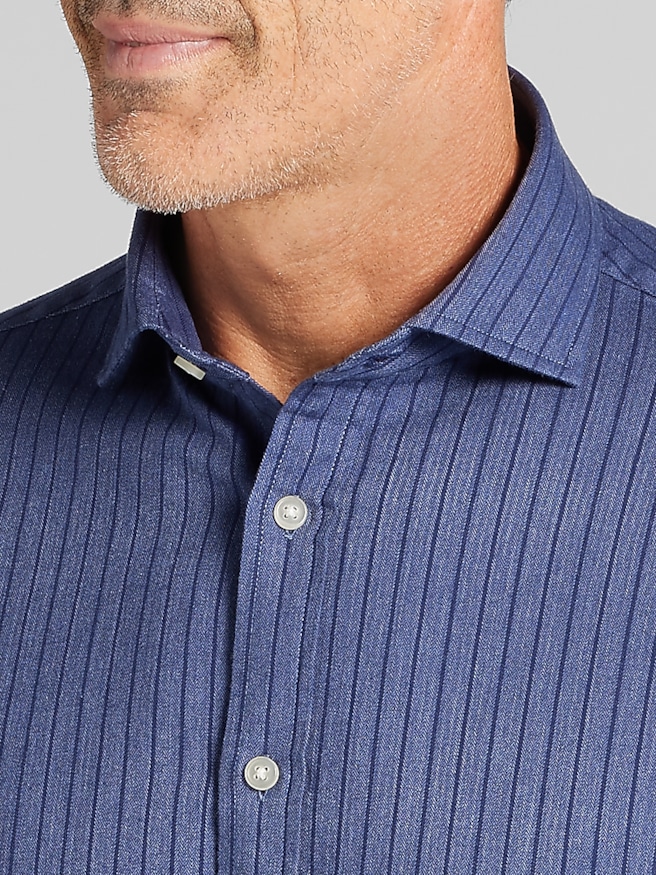
Men’s striped button-up shirts range from smooth cotton poplin styles that look sharp under a suit jacket to relaxed linen shirts that work just as well tucked into chinos as worn open over a plain tee. It’s the combination of a collar, a full row of front buttons, and a repeating pattern that makes the style so versatile. Fine blue stripes on a white ground can read almost like a solid from across a room, then show their detail at the cuffs and collar up close. Broad bands of navy and cream are more noticeable and can give a simple pair of jeans enough contrast without adding another pattern. Spacing matters as much as width: closely set lines give the shirt an even look, while stripes with plenty of space between them stand out individually. Within the broader selection of Men's Striped Shirts, the button-up stands out for how easily the same pattern can look polished or casual, depending on the cloth and cut. A light, smooth poplin lets fine lines look crisp, while the more substantial feel of Oxford cloth suits a softer collar and an outfit built around chinos or dark denim. Cotton twill has a subtle diagonal texture in the weave and often drapes more softly than crisp poplin. Linen has small variations in texture that give the stripes a less uniform look, and its natural creases fit the character of a more casual shirt. A cotton-linen blend can strike a middle ground between the two fabrics. Even the collar changes how a stripe comes across. A spread collar leaves space for a tie knot, while a button-down collar, named for the buttons that hold its points in place, keeps things neat when the top button is open. Both are button-up shirts; the distinction is in the collar, not the way the shirt closes.
Fit is especially visible on a striped shirt. Lines that bend around the chest or pull sideways at the buttons often signal that the shirt needs more room, even if it feels fine while standing still. A shirt for a desk job or a long dinner should also sit comfortably when the wearer reaches forward or takes a seat. On a traditionally cut shirt, the shoulder seams sit near the ends of the shoulders, and long sleeves reach the wrists without bunching heavily at the cuffs. A tailored fit reduces extra fabric at the waist, which can make it easier to tuck the shirt into dress trousers. A classic fit generally offers more room through the chest and waist, while a relaxed cut leaves space to wear the shirt over a tee without the sleeves or front feeling crowded. The hem is another clue to how the shirt is meant to be worn. Longer, curved tails help the shirt stay tucked when the wearer sits or reaches. A shorter hem that falls around mid-fly can look more balanced untucked with jeans or casual trousers. For a meeting where a solid shirt feels a little plain, fine stripes in blue or gray add some definition beneath a navy or charcoal jacket without taking attention away from the tailoring. With a tie, a solid color is a straightforward match; a small pattern can also work when it’s noticeably larger or smaller in scale than the stripes. Away from the office, a wider stripe, an open collar, and sleeves rolled neatly to the forearms make the same basic silhouette feel less formal. Pairing a high-contrast stripe with plain trousers lets the shirt set the tone, while lower-contrast stripes leave more room for a textured layer, such as a knit sweater or an unstructured jacket.
Fabric and construction both affect how a striped button-up holds up with regular wear. A densely woven cotton can be a practical choice for a shirt that will see frequent use, but the areas that take the most strain are worth a look regardless of fabric. Even stitching, a flat button placket, and securely sewn buttons are useful details, particularly at the cuffs and near the waist, where the shirt bends and pulls throughout the day. On some styles, stripes align across the chest pocket so it blends into the shirt; on others, the pocket is cut at an angle to make it stand out. Either can look deliberate when the pocket lies flat and the stitching is tidy. Care depends on the fabric and finish, so the label is the best starting point. When machine washing is permitted, cool water and washing with similar colors can help keep pale stripes clear and darker ones from fading prematurely. High dryer heat can contribute to shrinkage in cotton and linen, which is noticeable when sleeves come up short or a hem no longer stays tucked as easily. Hanging the shirt after washing, if the label allows it, can soften creases and make pressing easier. A light press at the collar, cuffs, and front placket brings back the clean lines of a dressier shirt, while a casual linen style doesn’t need to be perfectly smooth. As a gift, a striped button-up can suit someone building a work wardrobe or someone who tends to wear solid shirts and wants a little more pattern. A favorite shirt is often a better fit reference than the size label alone: shoulder width, sleeve length, and whether the wearer usually tucks it in all offer clues. A narrow stripe in a familiar color is easy to pair with clothes already in the closet, while a bolder stripe makes sense for someone who likes a shirt to be the most noticeable part of an outfit.