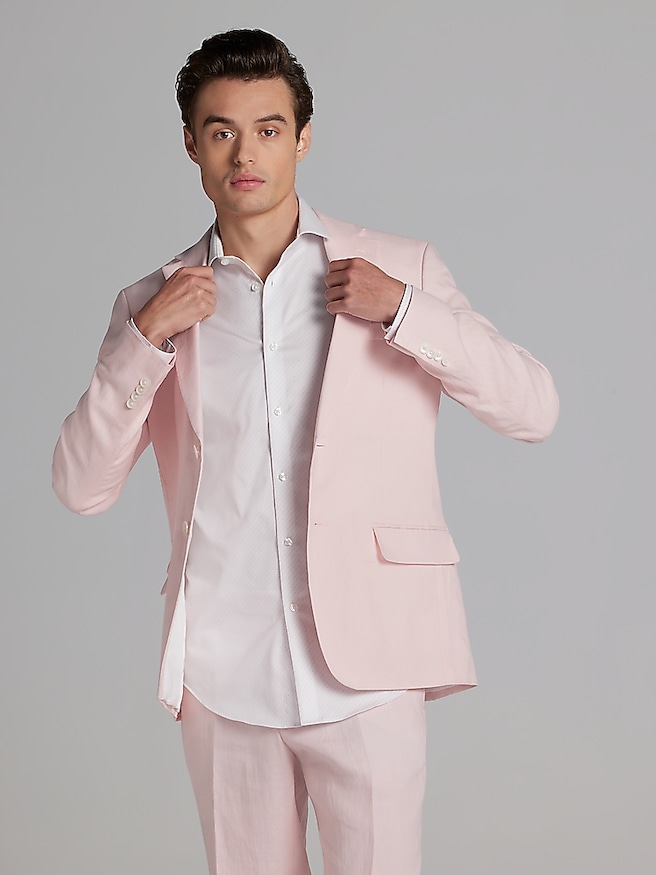
Men’s pink clothing spans casual shirts, activewear, and dressier apparel, with shades that can look understated in an office or stand out at a reception. Pale blush sits close to a neutral, especially next to navy, warm gray, or stone. Dusty rose has more depth without a sharp contrast, while coral and fuchsia put the color front and center. For an office with a business-casual dress code, a pale pink shirt with charcoal trousers gives the outfit about as much contrast as a light blue shirt would. At a wedding, muted rose can bring out the texture of navy tailoring without drawing attention away from the rest of the outfit. A brighter shade looks at home with dark denim for a birthday dinner, where there’s less need to keep the color subtle. The fabric can change how a shade reads as much as the dye does: a matte weave softens the color, ribbing breaks it up with small shadows, and a smooth, lustrous finish reflects more light. Even two shades that look nearly identical at first glance can have distinct undertones. A peach-leaning pink fits naturally alongside cream and tan, while a cooler pink with a hint of blue echoes the tones in slate and charcoal. Those distinctions matter most when the colors sit next to each other, such as at an open collar or where a shirt meets the waistband. For casual outfits, Mens Pink Short Sleeve Shirts can bring color to a simple combination of straight-leg jeans and sneakers or pleated trousers and loafers. Pink can also work from head to toe without looking like every piece came from a set. A muted pink knit and deeper rose trousers have enough contrast to show where one piece ends and the other begins, even though both belong to the same color family.
Fabric and fit help distinguish pink clothing meant for everyday wear from apparel designed for exercise or a formal setting. Cotton jersey typically has a soft finish and enough give for relaxed movement, while woven cotton generally holds a collar and front placket in a cleaner line. A fine, tightly woven cloth can look crisp under a jacket; a textured weave makes the color appear less flat and gives casual clothing some character even without a pattern. Blends with a small amount of stretch can make fitted clothing more comfortable across the back or through the thighs. For activewear, stretch recovery matters as much as the initial give: fabric that returns to shape after a set of lunges is less likely to sag at the knees. Smoother seams help reduce rubbing during repeated movements. Tailored clothing has a separate set of fit considerations. A shirt that looks neat when standing may pull across the front when reaching for a steering wheel, and a jacket should let the arms settle naturally without bunching at the back of the neck. Lighter shades make details like pocket outlines, seam ridges, and tension lines easier to see. A pale woven fabric that looks opaque on a hanger may show an undershirt seam once it stretches across the shoulders, so it helps to consider how the fabric sits in motion as well as at rest. Cloth weight alone isn’t a measure of durability. A lighter fabric with an even weave and secure stitching can hold up well to regular use, while loose knits may snag when they brush against a rough surface. On clothing worn often, the areas that usually show wear first are the collar, cuffs, pocket edges, and anywhere a bag strap regularly rubs.
Care matters for pink clothing because fading, dye transfer, and changes in texture can alter both the color and the way the fabric hangs. The care label is the best starting point, especially for lined tailoring or clothing made from several fibers. For washable pieces, sorting by color helps keep pale pink from picking up loose dye from dark denim. A vivid pink garment is better washed with similar shades until it’s clear whether it releases color. Turning washable knits inside out can limit friction on the visible surface, and avoiding unnecessary high heat can help protect fibers that provide stretch. A stain on a pale shade can be easy to spot but harder to remove evenly: blotting instead of scrubbing helps avoid leaving a rough patch around the original mark. Any treatment should be compatible with the fabric and tested on a hidden area if there’s a chance it could affect the dye. For structured tailoring, a wide hanger supports the shoulders, while folding a heavier knit helps prevent the neckline from stretching under its own weight. These practical details matter when choosing pink apparel as a gift, too. For someone who sticks to navy, gray, and denim, a soft rose shade pairs readily with what’s already in the closet. A bolder pink makes sense for someone who already reaches for saturated colors or likes a little contrast in workout clothes. Knowing how the recipient wears their clothes is more useful than knowing the size on a single label: someone who favors a relaxed fit may want room through the chest and upper arms, while someone who usually dresses in layers may get more use out of a closer fit that sits neatly under a jacket. The same idea applies to choosing clothing for a special event. A pink piece that fits the dress code and works with familiar colors is more likely to find a place in everyday outfits long after the occasion.