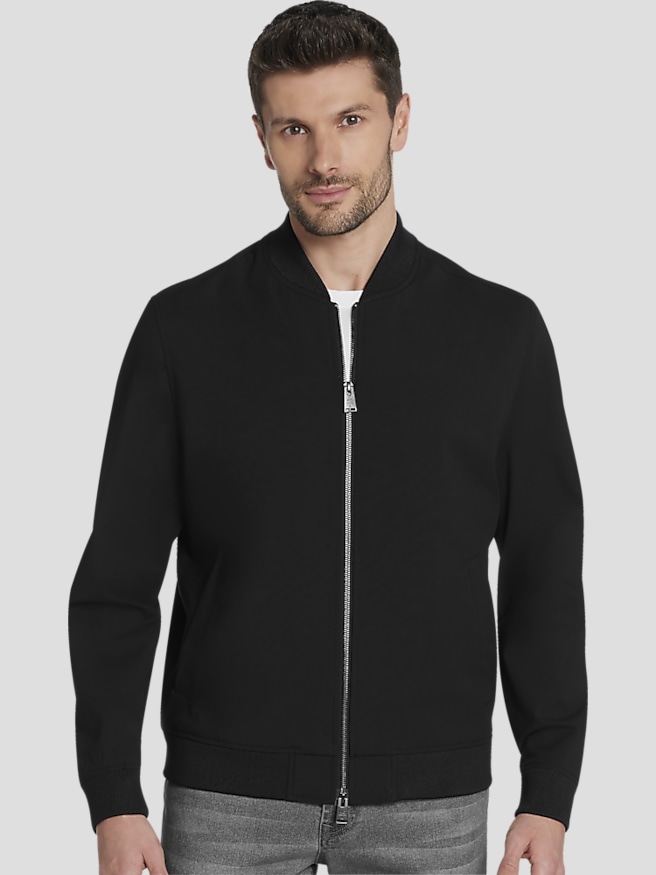
Men’s lightweight bomber jackets combine a short, defined silhouette with a low-bulk construction that fits easily into an everyday wardrobe. Drawing on the shape of classic flight jackets, they typically feature a zip front, a close-fitting collar, and ribbed or elasticized cuffs and hems. The key distinction is construction: a lightweight bomber generally has little or no substantial insulation, although the shell fabric, lining, and trim all contribute to its overall weight and feel. That makes fabric and lining details more useful than the word “lightweight” alone when comparing styles. An unlined cotton bomber can feel soft and relaxed, while a nylon shell with a smooth lining may slide more easily over a long-sleeve shirt. Polyester fabrics can provide a clean surface and resist wrinkling, depending on their weave and finish. Cotton blends often have a familiar, less slick hand, and a small amount of elastane can add give across the shoulders and elbows. Ripstop fabric has a reinforcing grid designed to help limit the spread of small tears, but it is not immune to abrasion or damage. A tightly woven shell may feel more structured than a loose weave of similar weight; breathability also depends on construction, coatings, and lining rather than fiber content alone. Matte finishes give the jacket an understated appearance, while a subtle sheen emphasizes its athletic roots. Navy, black, olive, gray, and tan are versatile color families, with darker shades creating a crisp outline and lighter neutrals highlighting seams and texture. Details such as a sleeve pocket, tonal zipper, or contrast lining can shift the character from utilitarian to refined without changing the basic shape. For daily commuting, travel, casual office settings, or an evening at a neighborhood restaurant, the appeal is straightforward: a lightweight bomber adds definition over a simple shirt without the length or structure of a tailored jacket.
Fit determines whether that compact shape looks intentional and feels comfortable through a full day. A men’s lightweight bomber jacket should generally sit near the waist or upper hip, with enough room through the chest to zip comfortably over the intended base layer. Exact length varies by design and body proportions, so the hem’s position matters more than a fixed measurement. A waistband that rests lightly against the body preserves the bomber’s shape; one that grips too tightly can make the fabric bunch above it. With a set-in sleeve, the shoulder seam should fall close to the edge of the shoulder unless the design deliberately uses a dropped shoulder. Sleeves should reach roughly to the wrist, allowing the cuffs to settle without covering much of the hand. Reaching forward, sitting down, and bending the elbows are useful checks for pulling across the back or pressure at the armholes. A slim cut can work well over a T-shirt or fine-gauge knit, while a regular or relaxed cut leaves more space for an overshirt or lightweight sweatshirt. Sizing up is not always the best answer for layering, since it can also add unwanted sleeve length and shoulder width; comparing garment measurements and fit descriptions gives a clearer picture. Proportion matters below the jacket, too. Straight-leg jeans keep the outfit easygoing, while tapered chinos create a cleaner line without requiring a tight fit. A plain crewneck lets the rounded collar stand on its own, and a Henley adds texture without much bulk. A button-down shirt can also work when its collar sits neatly and the fabric is not crowded beneath the jacket neckline. For a casual workplace, a matte bomber over an Oxford shirt with chinos and loafers feels composed but not formal. For a long drive or a day spent walking around a city, stretch fabric, comfortable armholes, and secure pockets may matter more than decorative details. The best choice supports the way the jacket will actually be worn, rather than looking good only while standing still.
Construction and care have a large influence on how well a lightweight bomber maintains its appearance. Even stitching, neatly finished interior seams, and secure pocket openings are useful signs to examine, particularly around areas that receive repeated stress. A zipper should move smoothly without catching the lining, and its base should connect cleanly without needing force. Rib-knit cuffs and hems should recover after gentle stretching; trim that stays loose can change the jacket’s outline. Pocket placement deserves attention as well. Angled hand pockets are convenient during everyday wear, while zippered or interior pockets can help keep small essentials contained. Carrying a bulky phone, keys, and a wallet in the same pocket can pull a lightweight shell out of shape, so distributing those contents helps preserve its line. Care requirements vary across cotton, synthetic fabrics, blends, and specialty finishes, making the sewn-in care label the starting point. Some jackets allow machine washing, while others require professional cleaning or more limited treatment. When washing is permitted, following the specified cycle and drying method helps protect both the shell and the stretch components in the trim. High heat can damage some synthetic fibers, elastic, or applied finishes, and fabric softener may be unsuitable for certain performance treatments. Addressing a small mark promptly with a care-label-approved method can prevent unnecessary full washes. Between wears, emptying pockets and placing the jacket on a broad, supportive hanger helps it retain its shape. For travel, avoiding sharp, prolonged folds can reduce creasing, although wrinkle recovery depends on the fabric. A lightweight bomber can also make a thoughtful gift for someone who prefers practical clothing with a defined silhouette, especially when the recipient’s usual size, preferred colors, and layering habits are known. Someone who wears untucked shirts may appreciate a slightly longer body, while a minimalist dresser may favor discreet pockets and matching trim. For another category to compare, men’s lightweight spring jackets provide a related starting point beyond the bomber silhouette. Within the bomber category, the most useful balance is a comfortable fit, a fabric suited to everyday routines, and finishing details that remain easy to wear and maintain.