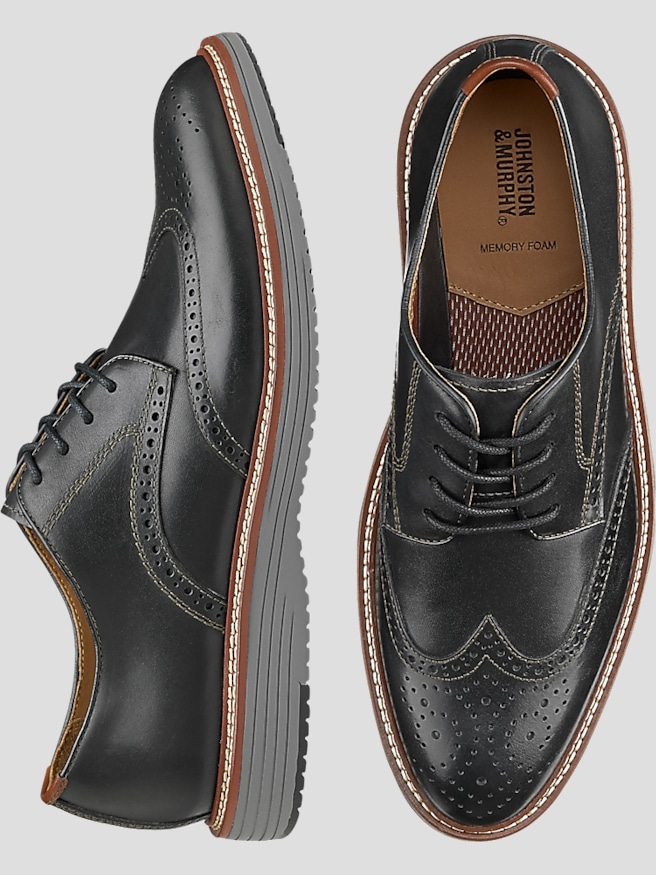
Men’s brogue shoes are dress shoes distinguished by decorative perforations, known as broguing, along the seams, toe caps, and other sections of the upper. Those small punched details give the shoes their character, adding texture without relying on bold hardware or contrasting colors. Broguing describes the decoration rather than the shoe’s construction, so both Oxfords and Derbies can be brogues. An Oxford’s closed lacing creates a neat, streamlined appearance, while a Derby’s open lacing gives the upper a slightly more relaxed look and can offer greater adjustment over the instep. The amount of decoration also changes the effect. Full brogues, often called wingtips, have a pointed toe panel with extensions that sweep back along the sides. Semi-brogues generally feature a straight toe cap with perforations and a decorative toe medallion, while quarter brogues typically keep the detailing to the cap’s edge. These distinctions make it possible to choose anything from a restrained business shoe to a more expressive finish for tailored separates. Smooth leather emphasizes the pattern clearly, with black offering a crisp complement to charcoal trousers and dark brown working naturally with navy, gray, and earth tones. Tan leather makes the detailing more noticeable, while burgundy adds depth without requiring a brightly colored outfit. Suede softens the appearance and pairs especially well with textured trousers and less structured tailoring. Material descriptions matter beyond appearance: full-grain leather retains the hide’s natural surface, while other leather finishes may have a more uniform look. Neither color nor decoration alone determines durability; leather quality, construction, fit, and regular care all contribute. For office meetings, wedding celebrations, graduation ceremonies, or a dinner that calls for more than sneakers, brogues offer a recognizable dress-shoe shape with enough visual interest to stand on its own. Their decorative character generally makes them less formal than an otherwise comparable plain dress shoe, an important distinction for occasions with strict dress requirements.
A good fit lets that detailing look its best without making the shoe feel restrictive. The toes should have room to rest naturally, the ball of the foot should sit comfortably at the shoe’s widest point, and the heel should feel secure rather than lifting excessively with each step. A long, tapered toe can extend beyond the foot as part of the design, so empty space at the very tip does not necessarily mean the shoe is too large. Pressure across the widest part of the foot, pinching at the little toe, or persistent rubbing at the heel deserves more attention than the number printed inside. Leather may soften and conform with wear, but it should not be expected to correct a shoe that is too short or fundamentally too narrow. Trying dress shoes with the socks intended for them gives a more useful sense of fit, especially when moving between thin dress socks and more substantial everyday pairs. Anyone who uses an orthotic should account for its depth and check whether the footbed is removable rather than assuming every brogue will accommodate it. Comfort also depends on how the shoe will be used. A pair worn mainly at a desk faces different demands from shoes worn through a full day of presentations, a lengthy reception, or repeated walks between buildings. Leather linings can help manage moisture, cushioned footbeds may soften the feel underfoot, and the shape of the last—the form used to build the shoe—affects room through the toe and instep. Outsole material deserves similar attention. Leather soles have a traditional dress appearance, while rubber soles can provide flexibility and grip depending on their design. No sole performs identically on every surface, and a sleek profile does not by itself indicate comfort. Welted construction may allow resoling when the upper remains sound, although repair options depend on the individual shoe. Well-fitted brogues with suitable support and construction can become dependable companions for a regular work wardrobe, not just shoes reserved for occasional photographs.
The most convincing outfits give brogues enough space to contribute without making every detail compete. Dark brown semi-brogues beneath navy trousers can look composed with a light blue shirt and a textured jacket; tan wingtips with gray chinos create a more relaxed contrast. Black brogues suit many business settings, though highly formal evening dress usually calls for footwear chosen specifically for that dress code. A trouser hem with a clean break keeps the toe pattern visible and avoids a heavy stack of fabric over the laces. With jeans, a dark wash and a tidy hem help the shoes feel connected to the rest of the outfit rather than overly dressed up. Matching a leather belt reasonably closely in color and formality creates continuity, but an exact shade match is rarely necessary. For a more casual interpretation of the perforated detailing, Men's Brogue Sneakers carries the same visual idea into a sneaker silhouette. Traditional leather brogues benefit from straightforward, consistent care that respects the material. Dust can collect around the perforations and stitched edges, making a soft brush useful for keeping the pattern distinct. Smooth leather generally benefits from suitable conditioner and polish used according to the maker’s directions; heavy buildup can obscure fine detailing rather than improve it. Suede needs its own brush and compatible care products instead of standard leather cream. Cedar shoe trees can help maintain shape and absorb residual moisture, while allowing shoes to air between wears helps the interior dry fully. Shoes that become damp should dry naturally away from direct heat, which can damage leather. Attention to worn heel edges, loose stitching, and thinning soles can also make repairs more manageable before damage spreads. As a gift for a father, partner, brother, or recent graduate, brogues can mark a new job, professional milestone, or personal celebration with something useful beyond the occasion. Familiarity with the recipient’s fit and usual wardrobe matters more than choosing the most elaborate pattern. A well-chosen shape, practical color, and comfortable fit give the decorative details a lasting place in everyday dressing.