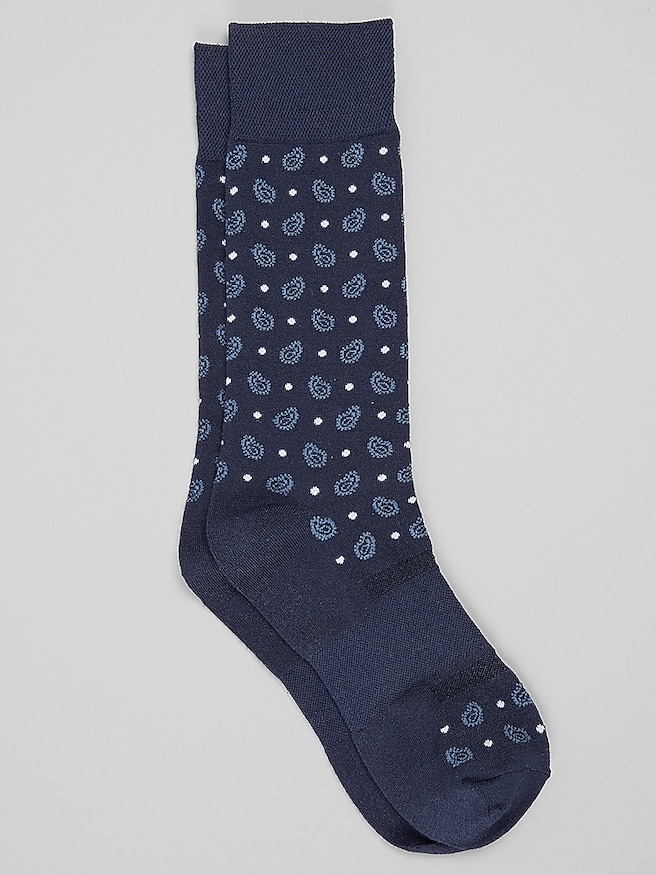
Designer socks bring distinctive color, pattern, and knit detail to an everyday essential, giving a familiar outfit a more personal finish. Their appeal lies in the combination of visual character and practical comfort: a stripe that picks up a shirt color, a small geometric motif beneath tailored trousers, or a finely ribbed solid that complements polished leather shoes. The term can describe socks associated with a designer label, but the label alone does not explain how a pair will feel or perform. Fiber content, construction, fit, and finishing details remain important distinctions. For men who wear suits, dress socks create a continuous line between the trouser hem and the shoe, especially when sitting down or crossing a leg. A dark, understated design keeps that transition quiet, while a contrasting pattern makes the socks an intentional part of the outfit. Navy trousers with burgundy accents, charcoal tailoring with a subtle blue motif, or chinos with narrow stripes offer personality without requiring every accessory to match. The visual range of patterned socks makes them useful for both restrained combinations and more expressive looks. Scale matters as much as color: small repeats tend to read as texture from a distance, while wide stripes and larger shapes are easier to notice. A patterned tie or checked jacket usually pairs comfortably with a quieter sock design, leaving the strongest visual element room to stand out. With a solid suit and plain shirt, socks can carry more of the outfit’s character. Weddings, business dinners, presentations, and everyday office dressing each leave room for a different degree of expression. For a coordinated wedding party, shared colors can create cohesion without making every detail identical. Outside tailored settings, designer socks also work with denim, casual trousers, loafers, and sneakers, where a visible cuff becomes part of the overall silhouette. The result can be subtle or playful while still looking considered rather than accidental.
Materials and construction shape the experience of wearing designer socks long after the first impression. Cotton contributes a soft, familiar feel and absorbs moisture, although it does not necessarily dry as quickly as some synthetic fibers. Fine wool, including merino, can provide softness and help manage moisture without the bulk associated with heavier knits. Blends may combine those qualities with nylon for abrasion resistance and a small amount of elastane for stretch and shape recovery. A high percentage of one natural fiber is not automatically a better choice; the balance of fibers needs to suit the intended use. A lightweight, smooth knit generally fits more comfortably inside close-fitting dress shoes, while a slightly more substantial construction may feel appropriate with roomier casual footwear. Cushioning can soften contact under the heel and forefoot, but too much thickness in a snug shoe can crowd the toes or change how the shoe fits. Fine-gauge knitting, an evenly finished toe seam, and a well-shaped heel pocket are useful details for anyone spending a full day at a desk, walking between appointments, or standing through a reception. Reinforced heels and toes can help protect areas that experience repeated friction, though overall durability also depends on shoe fit and care. Sock length changes both coverage and appearance. Crew lengths suit many casual combinations, while longer dress styles provide more coverage beneath trousers when seated. An over-the-calf design may appeal to someone who prefers a higher cuff, provided the leg fit feels comfortable. The cuff should hold without constant adjustment, and the foot should lie smoothly rather than bunch beneath the arch or pull tightly across the toes. Size ranges deserve attention because a stretched pattern, misplaced heel, or excess fabric can signal a poor fit. Shoe size is a useful starting point, but foot shape and calf circumference also affect comfort. For regular travel or long workdays, these construction details can matter more than an elaborate motif.
Care helps preserve the appearance, softness, and shape that make designer socks enjoyable to wear. The care label is the best reference because cotton blends, fine wool, and delicate specialty fibers may need different handling. Turning socks inside out before washing can reduce direct rubbing against the visible surface, and a mesh laundry bag can keep pairs together while limiting tangling with other garments. Washing with similar colors helps protect lighter designs from color transfer. For machine-washable pairs, a gentle cycle and a detergent appropriate to the fiber can reduce unnecessary wear; wool may require a wool-specific detergent and a gentler cleaning method. Excessive heat can affect elastic fibers and contribute to shrinkage, so drying instructions deserve the same attention as washing instructions. Air drying is a useful option when the label allows it, with delicate knits laid flat to avoid stretching. Pulling socks on by easing them over the foot, rather than sharply tugging the cuff, also limits strain on the fabric. Rough shoe linings, tight toe boxes, and repeated friction at the heel can shorten their useful life even when laundering is careful. Rotating several pairs gives each one time to dry fully between wears and spreads use across the collection. Designer socks can also make a thoughtful gift because they combine practical value with room for individual taste. For someone who wears tailoring daily, understated colors and fine patterns are easy to work into an established wardrobe. A recipient who enjoys expressive accessories may appreciate bolder stripes, unexpected color combinations, or distinctive knit textures. Birthdays, graduations, anniversaries, and professional milestones offer natural occasions for a gift that feels personal without requiring the same detailed measurements as a suit. Knowing the recipient’s shoe size, preferred sock height, and usual footwear makes the choice more useful. Whether worn beneath formal trousers or shown above casual shoes, well-chosen designer socks add a finishing detail that can feel as comfortable as it looks.