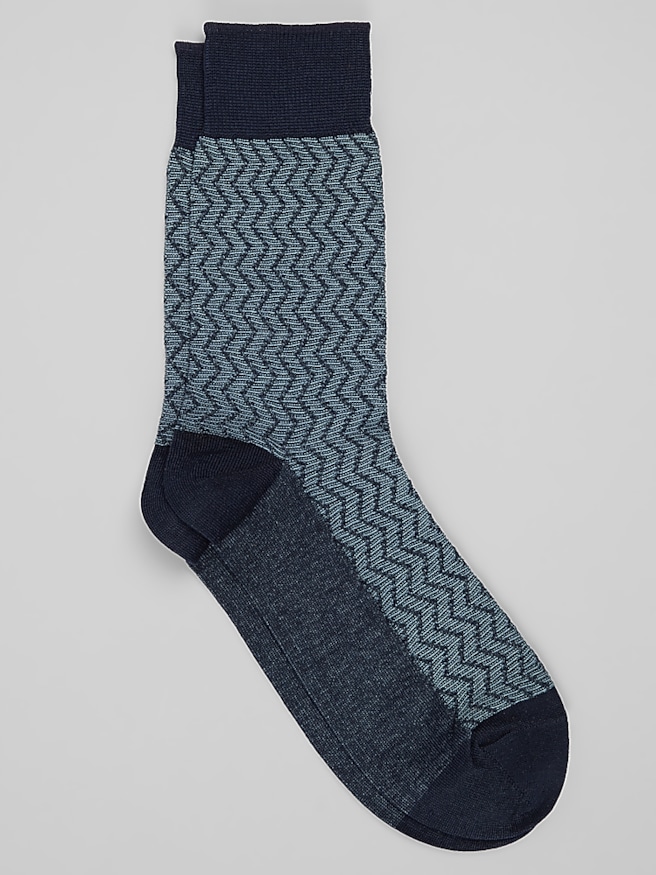
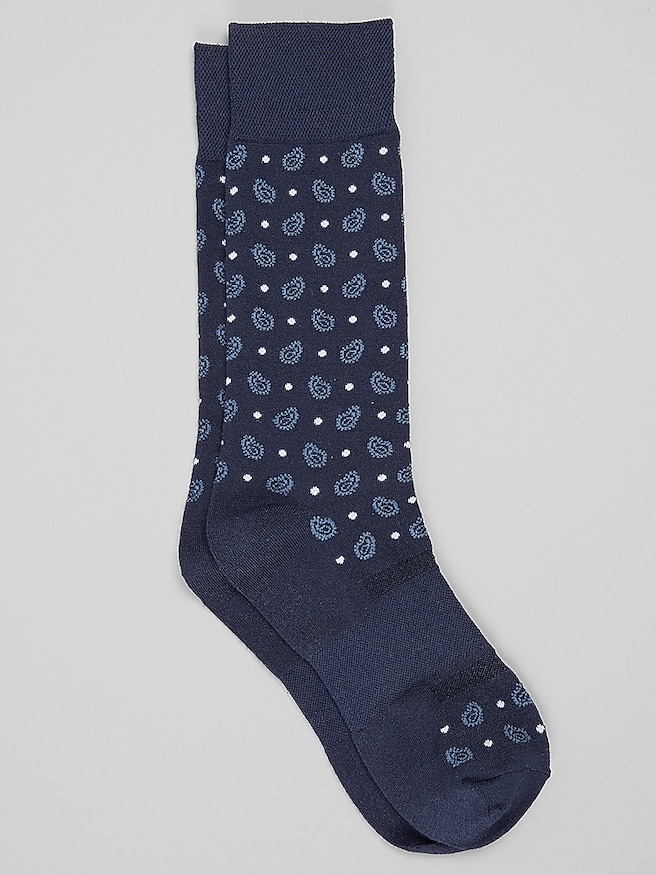
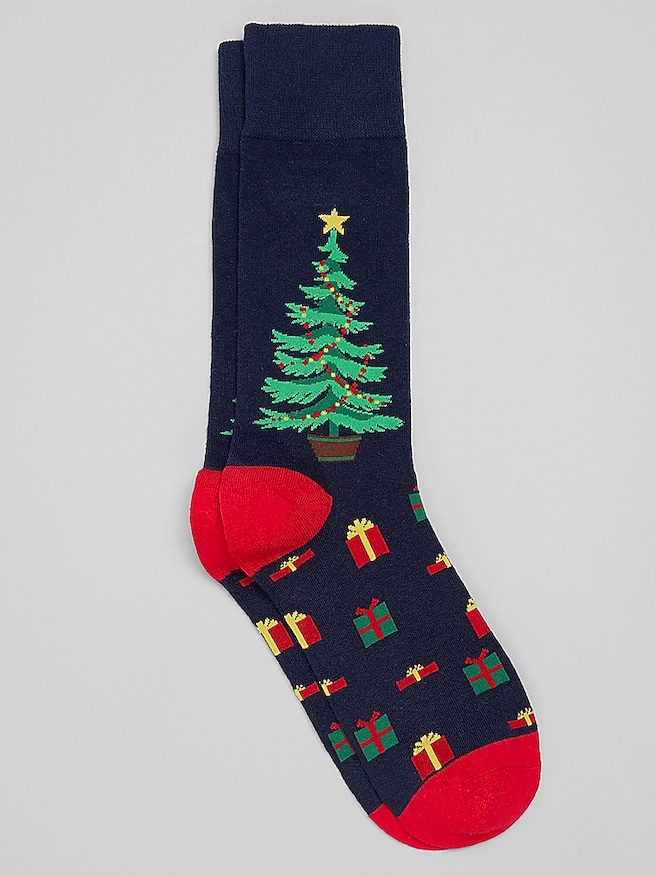
Colorful socks bring bright solids, stripes, geometric designs, and playful patterns to an everyday essential. A glimpse of cobalt beneath charcoal trousers or a burgundy diamond pattern above brown leather shoes adds personality without changing the character of an entire outfit. For men who spend much of the day in tailored clothing, that small patch of color can make familiar combinations feel more individual. Solid jewel tones offer a restrained starting point, while dots, contrasting stripes, and larger motifs create a more noticeable accent. The effect depends as much on scale as on shade: a fine pattern often reads as subtle texture from a distance, while broad bands of color stand out when crossing a leg or sitting at a desk. Navy trousers pair naturally with shades of blue, green, and burgundy, and gray tailoring provides a neutral backdrop for purple, teal, or a muted orange. Picking up a secondary color from a tie, shirt, or pocket square creates a connection without requiring an exact match. When a shirt already has a prominent check or stripe, socks with a quieter pattern help keep the combination balanced. With dark jeans or chinos, stronger contrasts can feel relaxed, especially when the socks appear between a clean trouser hem and loafers or sneakers. Dress codes still matter: understated patterns and deeper colors tend to sit comfortably within traditional business settings, while expressive prints suit creative workplaces, dinners, and casual gatherings. At weddings, coordinated sock colors can give the wedding party a shared detail without making every outfit identical. The most versatile choice is often a color that already appears elsewhere in a wardrobe, since it works with familiar clothing while offering something beyond basic black. Colorful dress socks can be discreet beneath full-length trousers or more visible with a slightly shorter hem, making them an accessory whose impact changes with the outfit rather than demanding attention in every setting.
Fabric, construction, and fit shape the experience of wearing colorful socks just as much as their appearance. Cotton is valued for its soft feel and moisture absorption, and cotton blends often include synthetic fibers to improve shape retention and resistance to everyday wear. Polyester and nylon can contribute strength, help fabric dry more readily, and support a smoother, lighter knit. A small amount of elastane adds stretch so the sock can follow the foot and recover after movement. Merino wool blends offer moisture management and a comfortable feel across a range of everyday activities; their performance depends on the blend, knit, and thickness rather than the fiber name alone. Rayon or viscose made from bamboo can have a soft, smooth hand, but the full fiber label gives a clearer picture of the fabric than a broad material description. Fine-gauge socks generally fit more easily inside close-fitting dress shoes, while a more substantial knit may feel better with roomier footwear. Too much fabric can crowd the toes or create pressure across the top of the foot, even when the shoe itself is the correct size. A well-fitting heel should sit around the heel rather than pulling under the arch or bunching above the shoe. The toe area needs enough space to lie smoothly, and a comfortable cuff should stay in place without leaving a deep impression on the leg. Crew socks work with many everyday outfits, while taller dress socks provide more coverage when trouser hems lift during sitting. Reinforced heels and toes can help protect high-friction areas, and smooth toe seams may reduce rubbing during long hours on foot. Dense, even knitting also helps a pattern look defined when the fabric stretches. For office commutes, celebrations, or a full day moving between appointments, the right balance of coverage, cushioning, and shoe space matters more than color alone. Attractive socks earn a regular place in a wardrobe when they feel as considered as they look.
Good care helps colorful socks retain their appearance and fit through repeated wear. The care label is the best starting point because washing and drying needs vary by fiber blend and construction. Turning socks inside out before laundering can reduce surface abrasion, while washing with similar colors helps limit the effect of loose dye. A gentle wash and lower drying heat, when permitted by the label, are often kinder to elastic fibers than prolonged exposure to high heat. Fabric softener is not always suitable, particularly for performance-oriented materials, so any fabric-specific directions take priority over a general laundry routine. Keeping socks away from exposed zippers or hook-and-loop fasteners can help prevent snags, and a mesh laundry bag keeps smaller pieces together. Allowing socks to dry fully before putting them away supports a fresh, comfortable next wear. Rotating among several pairs also gives each pair time between uses and spreads friction across more than one set of heels and toes. These practical details are especially useful when a favorite pattern becomes part of a regular outfit. Colorful socks also make a thoughtful gift for someone whose clothing preferences are familiar: a rich solid for a dresser who favors understated details, a small geometric pattern for someone who enjoys tailoring, or a playful motif tied to a hobby or interest. Shoe size and preferred sock height are useful starting points, while the recipient’s usual footwear helps determine an appropriate thickness. For occasion-specific patterns, Fun Holiday Socks offers a related direction for celebratory dressing and gifting. Beyond a single occasion, a mix of restrained colors and expressive patterns gives socks a practical role in many wardrobes. Whether visible beneath a suit at a reception or peeking above sneakers on a casual outing, a considered pair combines useful everyday comfort with a detail that feels personal.