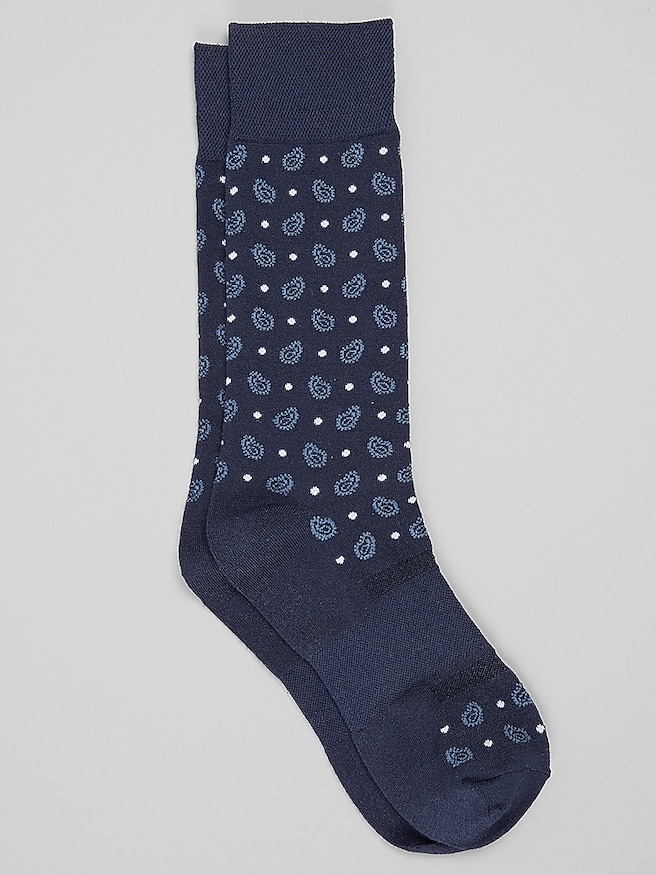
Men’s polka dot socks bring a repeating dot pattern to an everyday essential, adding personality to tailored clothing without requiring a bold shirt or jacket. The effect depends on the size, spacing, and contrast of the dots: small, closely spaced dots can read almost like texture from a distance, while larger dots in contrasting colors create a more noticeable accent. A navy background with pale blue dots fits naturally beneath navy trousers, and charcoal socks with muted burgundy dots can add depth to gray tailoring. Keeping the background close to the trouser color helps maintain a continuous line through the leg, with the pattern becoming visible when sitting down or crossing an ankle. For a more expressive combination, a brighter dot can pick up a secondary color in a tie, pocket square, or checked shirt. An exact match is not necessary; a shared color family usually looks more relaxed than repeating the same shade in every accessory. Polka dot dress socks work especially well with solid suits because the uncluttered fabric gives the small pattern room to stand out. With pinstripes or a checked jacket, a dot pattern in a different scale helps keep the outfit from looking busy. Think fine dots beneath a broadly checked trouser rather than several equally prominent patterns competing at once. The same socks can also suit chinos, dark denim, loafers, and lace-up shoes when the knit weight and overall styling are appropriate. In an office with conservative dress expectations, low-contrast dots offer a restrained alternative to solid socks; at a wedding or celebratory dinner, a stronger color combination can feel more at home. For another geometric pattern with a more linear effect, Men's Stripe Socks provide a useful comparison. Dots tend to feel playful without creating the directional emphasis of stripes, making them an easy way to add variety while keeping the rest of an outfit familiar.
Fabric, thickness, and construction matter as much as the pattern, particularly when socks need to feel comfortable through a commute, a full workday, and an evening out. Cotton blends are common in patterned socks because cotton provides softness and absorbs moisture, while companion fibers can improve strength, stretch, or shape retention. Cotton alone does not dry especially quickly, so the complete fiber blend matters more than a high cotton percentage by itself. Nylon and polyester can contribute durability, while a small amount of spandex or elastane helps the fabric stretch around the foot and recover after wear. Merino wool blends are another possibility in dress socks, valued for their fine feel and moisture management rather than a necessarily thick construction. Fiber content does not tell the whole story: a smooth, fine-gauge knit generally fits more easily inside close-fitting dress shoes than a densely cushioned sock. Extra padding can feel pleasant underfoot, but it also takes up space and may make an otherwise comfortable shoe feel tight across the toes or instep. Fit starts with the stated shoe-size range, then depends on how the heel, toe, and cuff sit on the body. The heel pocket should line up with the heel rather than riding under the arch or pulling up toward the ankle. Fabric should lie smoothly through the foot without bunching beneath the sole, and the toe seam should not create an uncomfortable ridge inside the shoe. Crew-length socks usually reach partway up the calf and suit many everyday outfits. Over-the-calf socks extend higher and can help maintain coverage when tailored trousers rise while seated. A supportive cuff should hold its position without pinching; repeatedly tugging at a slipping sock is a distraction during a meeting or ceremony. Stretch can also affect how the dots look, since an overly tight fit may pull round shapes into ovals. A well-proportioned fit preserves both comfort and the clarity of the pattern.
Durability in men’s polka dot socks comes from the combination of suitable materials, sound construction, good shoe fit, and consistent care. Reinforcement at the heel and toe can help in areas that receive repeated friction, though no construction makes socks immune to wear. Shoes that rub at the back of the heel, rough interior seams, and excess movement inside an oversized shoe can all place additional stress on the fabric. A smooth knit, neatly finished seams, and a cuff that recovers after stretching are useful construction details to consider alongside color. Care should follow the individual label, since fiber blends and finishing methods vary. For many washable styles, a cold, gentle cycle with similar colors helps limit unnecessary wear and color transfer. Turning socks inside out can reduce abrasion on the patterned surface, and a mesh laundry bag can keep pairs together while limiting tangling with other garments. Avoid bleach unless the care instructions expressly permit it, and use the recommended drying method rather than assuming every blend can tolerate high heat. Excessive heat can contribute to shrinkage or weaken stretch fibers over time. Letting socks dry fully before putting them away, rotating pairs between wears, and keeping toenails smooth can also help preserve their condition. Beyond everyday office clothing, dotted socks make a thoughtful gift for someone who enjoys a small detail that is visible only when a trouser cuff lifts. They can suit a graduate building a professional wardrobe, a partner who favors understated accessories, or a wedding party looking for a shared accent beneath coordinated suits. The most useful gift choice reflects the recipient’s shoe size, preferred sock height, and usual clothing colors, not simply the most striking pattern. Someone who wears charcoal trousers most days may get more use from dark socks with subtle dots than from a high-contrast design. Whether chosen for daily wear or a dressed-up occasion, the strongest combination is a pattern that feels personal, a fabric that works with the shoes, and a fit that stays comfortable long after the first impression.