
A tie can be an attractive color and pattern but still look awkward if the length is off. That’s because tie length sits right at the center of your outfit. It draws the eye down your dress shirt and creates a clean line from collar to belt. When the tie ends too high or hangs too low, the whole look can feel slightly out of proportion, even with a well-fitting suit.
Classic styling tipa say your tie should reach the middle of your belt buckle. But the right tie length can change based on your height and body type, knot choice, and whether you’re wearing a suit vest.
This guide explains how long your tie should be and what adjustments you can make before heading out the door.
The Golden Rule: Your Tie Should Hit the Belt Buckle
The proper necktie length for men is simple: It should land with the front blade ending around the middle of your belt buckle.
But where should a necktie end if you’re not wearing a belt? Aim for the center of your waistband. This balances the tie with your shirt, suit jacket, and trousers.
Here are some quick tips to remember:
- Too short: The tip of the tie ends above the belt, making the tie look undersized and leaving too much shirt showing between the tie and waistband.
- Just right: The tip reaches the middle of the belt buckle. This is the most balanced, universally flattering length for most men.
- Too long: A tie that hangs past the belt can make the outfit look heavy. It draws the eye down and throws off the proportions of your jacket and trousers.
Tie Length Check: Too Long, Too Short or Just Right?
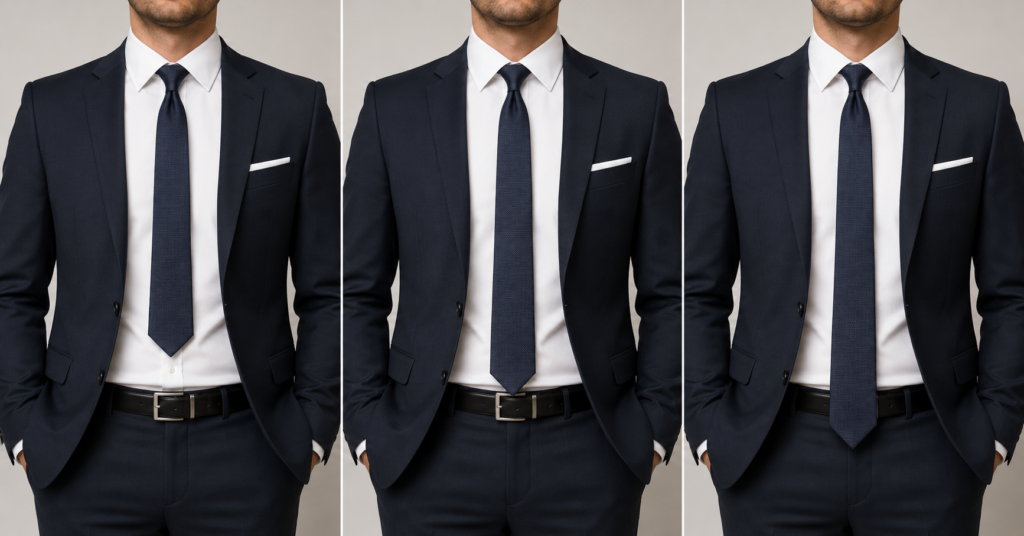
The mirror test is the fastest and easiest way to tell whether your tie is the correct length. Stand in front of the mirror with your shirt tucked in and your belt fastened. Don’t tug your tie down or straighten your posture unnaturally. Look at the front blade of the tie when figuring out the correct length.
| Tie Length | What It Looks Like | Why It Matters | Quick Fix |
| Too short | The front blade tip stops above your belt or waistband. | This makes the tie look undersized, especially with a suit jacket open. It leaves a visible gap between the tie and trousers that draws attention to your dress shirt instead of the full outfit. | Retie it with the wide front blade hanging lower before you make the knot. You can also use a smaller tie knot, like a Four-In-Hand, to save length. |
| Just right | The front tip lands at the center of your belt buckle or waistband. | This is the most balanced, flattering stopping point. | Tighten the tie knot gently, smoothen out the front blade from top to bottom, and tuck the narrow blade into the keeper loop behind the front blade to keep it hidden. |
| Too long | The front tip falls below the belt buckle. | Extra length makes the tie look sloppy, crowds the waistband, and makes the bottom half of your outfit | Retie your tie with the wide blade starting higher on your chest. A large tie knot, like a Half Windsor or Full Windsor Knot, can use up the extra fabric length. |
What Affects the Proper Tie Length?
The standard necktie length looks different from guy to guy. Your height impacts how the tie looks, but so do your torso, build, and knot choice.
Height
A taller man generally needs a longer tie than a shorter man. But the length of your torso tends to matter more than your overall height. Two men can both be six feet tall, but one may have a longer torso while the other has longer legs. The man with the longer torso may need more tie length because the tie has farther to travel. So the same standard necktie that sits perfectly on one man might stop short on another.
If you’re a taller man, you might also need to start with the wide blade hanging lower before tying the knot. If that still leaves the front blade above the belt, an extra long tie may suit you better.
Body Type
Body type affects how your tie sits. If you have a broader chest, larger neck, or fuller midsection, the tie has more surface area to travel over before reaching your belt. That can make a regular-sized tie look shorter, even if it looks long enough in your hands.
For example, a man with a larger neck likely needs more fabric to comfortably create a knot. Someone with a broader chest may find the tie lifts slightly or doesn’t fall as straight, so the front blade tip lands off-center. If that happens to you, start over with the wide blade hanging a little lower.
A few quick cues can help in front of the mirror:
- If the tie consistently stops above your belt, you may need an extra long tie or a smaller knot.
- If the narrow back blade hangs far below the front blade, adjust your starting point.
- If the tie pulls or curves across your dress shirt, check both length and how the knot sits beneath the collar.
The objective here isn’t to hide your body type but to make the tie work your frame so the entire outfit complements your silhouette.
Knot Style
The type of knot you choose can make a real difference in appearance because they all use different amounts of fabric. A smaller knot leaves more length in the front blade, while a larger knot leaves less.
Here are three of the most common tie styles to try:
Four-In-Hand Knot
The Four-In-Hand is slim, slightly angled, and easy to wear. It uses less fabric than larger knots, so it’s a great choice if your tie keeps landing a little short.
- How to tie it: Start with the wide blade hanging lower than the narrow blade, wrap it behind, bring it across the front again, and pull it up through the neck loop. Slide it down through the front loop you created, tighten, and pinch the knot slightly to shape it.
- Best for: standard collars, button-down collars, slimmer ties, and everyday suits.
Full Windsor Knot
The Full Windsor creates the largest, most symmetrical knot, so it uses the most fabric. It’s a good option if your tie runs too long, but it may make the length of a standard dress tie too short if you’re tall or have a longer torso.
- How to tie it: First, make sure the wide blade hangs much lower than the narrow blade. Cross it over the narrow one, pull it up through the neck loop, and bring it down to one side. Wrap it behind the narrow blade and wrap the wide blade across the front before pulling it up through the neck loop one last time. Slide it down through the front opening, and you have a Full Windsor Knot.
- Best for: wide-spread collars, formal suits, and larger frames.
Half Windsor Knot
The Half Windsor is the perfect middle ground if your tie length is close but the knot needs more structure.
- How to tie it: Start with the wide blade lower than the narrow blade. Cross the wide blade over the narrow blade, bring it behind, then pull it up and down through the neck loop to create one side of the knot. Wrap the wide blade across the front, bring it up through the neck loop again, and slide it down through the front opening.
- Best for: spread collars, medium-width ties, business suits, wedding suits, and dressier outfits.

Tie Your Look Together With Men’s Wearhouse
Tie length is a small detail, but it makes your outfit look complete. Once you know the belt-buckle rule, you can check your tie and adjust it in seconds. But what about the rest of your outfit?
Before your next big meeting, wedding, or formal event, Men’s Wearhouse can help you choose a tie that works with your build and the occasion. You can also get accessories like a tie bar to keep it neatly in place.
Visit a nearby store for a fitting and tie everything together at Men’s Wearhouse.
Shop Related Products