

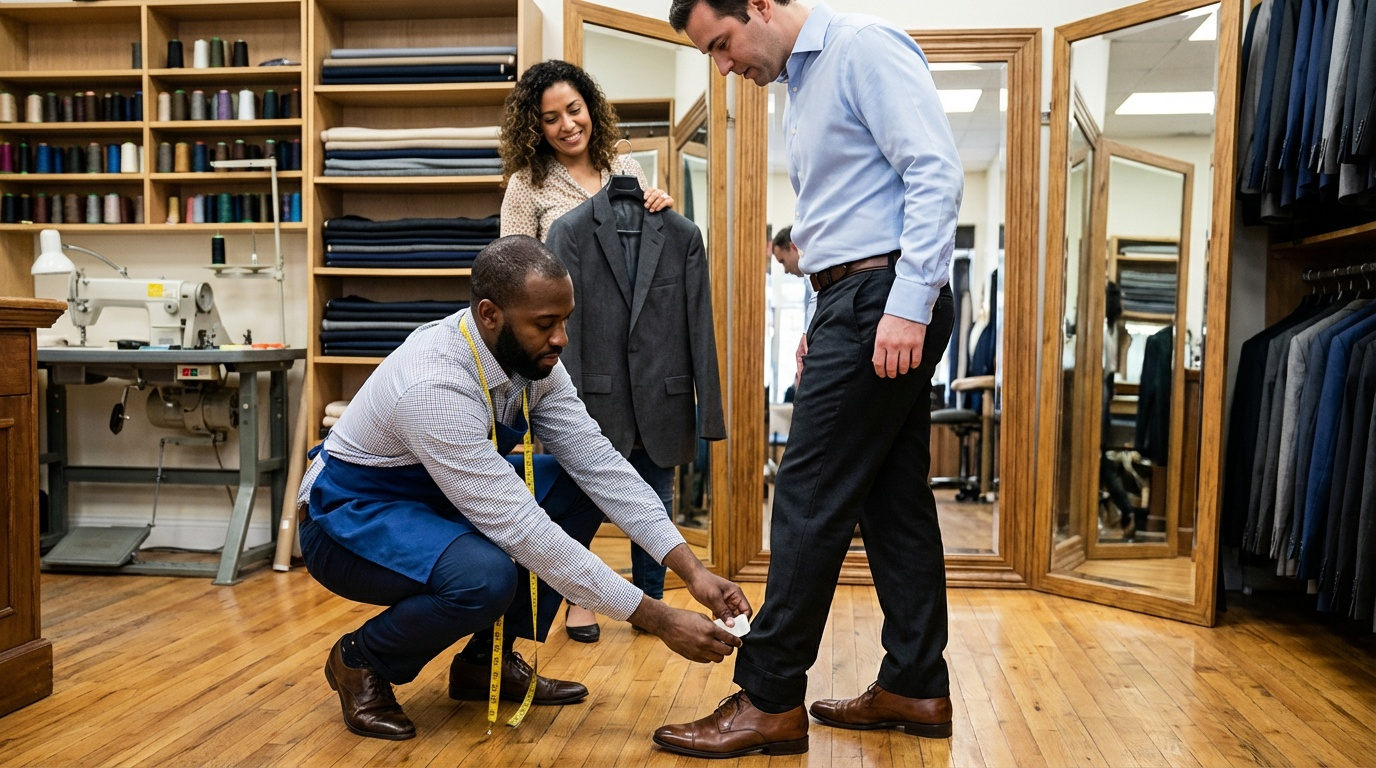

You found a suit that’s almost perfect. The price is right, the color works, but something feels off when you button it up. Before you talk yourself into “making it work,” you need to know what suit alterations can actually fix and what issues mean you should walk away.
Here’s the reality: some men’s suit alterations are simple, affordable fixes that transform an okay fit into a sharp look. Others are expensive gambles that still leave you with a suit that doesn’t quite work. Understanding the difference saves you money and ensures you look confident at that interview, wedding, or office presentation.
Most tailors can handle suit pants hemming, jacket sleeve shortening, and taking in suit pants waist with ease. These alterations are worth doing and typically take 5–10 business days. But letting out suit pants beyond an inch, adjusting suit pants thighs significantly, or reshaping shoulders? Those changes get complicated fast.
This guide breaks down every common suit alteration by type, cost, and whether it’s actually worth doing. You’ll learn which fixes give you the best return on investment and which ones signal it’s time to find a different suit.
Men’s suit alterations: what’s fixable vs. what’s not
A tailor can fix:
- Jacket sleeves too long (shortening is straightforward)
- Pants too long (hemming with plain or cuffed bottoms)
- Jacket or pants too loose in the waist and sides
- Pants break adjustment for proper drape over shoes
- Trouser leg width (tapering for a modern silhouette)
- Collar sitting away from the neck
- Minor length adjustments on the jacket body
- Adding or removing belt loops, suspender buttons
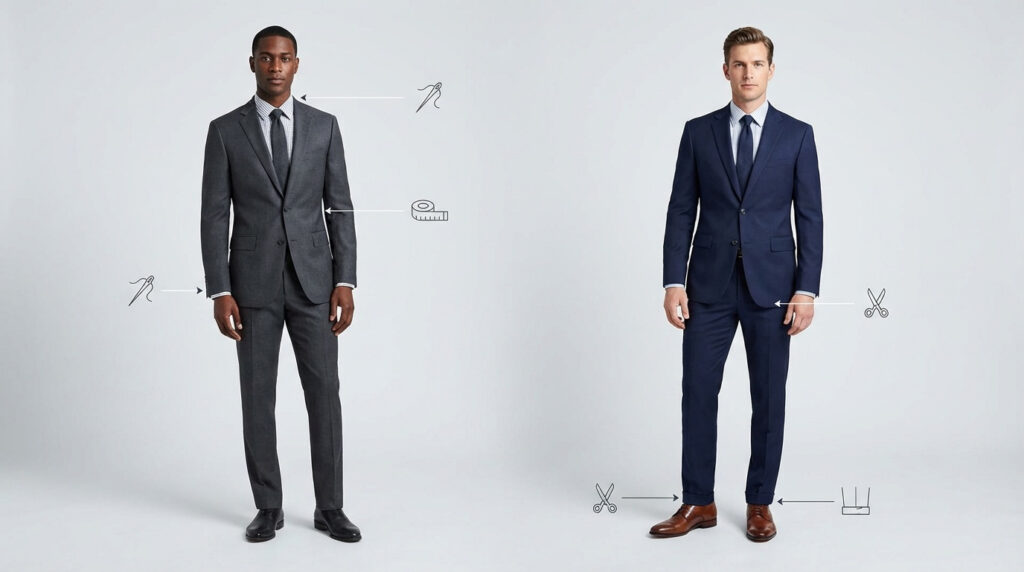
A tailor typically can’t fix (or shouldn’t try):
- Shoulders that are too wide, narrow, or drooping
- Chest that’s significantly too tight or baggy
- Pants rise (distance from crotch to waistband) issues
- Letting out more than 1–2 inches in most garments
- Pocket placement or proportion problems
- Jacket that’s more than 1 inch too long
- Fabric quality or construction defects
Men’s suit alteration value guide
| Alteration type | ROI level | Why |
|---|---|---|
| Suit pants hemming | High | Inexpensive, always looks better, changes your entire silhouette |
| Jacket sleeve shortening | High | Cheap fix, huge visual impact, shows proper shirt cuff |
| Taking in suit pants waist | High | Transforms fit, prevents bunching, reasonable cost |
| Jacket waist suppression | High | Creates tailored look, eliminates boxy appearance |
| Suit pants break adjustment | High | Small change with big polish, minimal cost |
| Adjusting suit pants thighs (taper) | Medium | Good for modern fit, but can’t change dramatically |
| Letting out suit pants (waist/seat) | Medium | Limited by seam allowance, only 1–2 inches possible |
| Collar adjustment | Medium | Fixes comfort issue but won’t save poor shoulder fit |
| Shortening jacket length | Low | Risky due to pocket placement, proportion changes |
| Shoulder alterations | Low | Expensive, complex, rarely worth the investment |
| Pants re-cut | Low | Costs $100+, usually cheaper to buy different pants |
| Removing pleats | Low | Expensive alteration, won’t fix underlying fit issues |
Suit alterations guide: jacket and trouser adjustments for the perfect fit
Think of this as your practical suit alterations guide: two buckets, two goals. Suit jacket alterations refine the top half (sleeves, waist, collar) so the jacket looks clean when you stand and move. Trouser work dials in the lower half, where suit pants hemming, suit pants break adjustment, and taking in suit pants waist usually deliver the biggest visual payoff. Start with fit fundamentals off-the-rack, then tailor for polish. Keep expectations realistic: letting out suit pants is limited by available fabric, so sizing still matters.
Bring this mini-checklist to your fitting:
- The shoes you will actually wear
- The dress shirt (and belt if you will use one)
- Any underlayers you plan to keep on
- Your event date and a little time buffer
- A clear “must-fix” vs. “nice-to-have” list
The tailor’s rule before anything else: men’s suit shoulders first
If the shoulders don’t fit, don’t buy the men’s suit. Shoulders are the hardest and most expensive area to change on any jacket.
Here’s why this matters: the shoulder seam should sit right at the edge of your natural shoulder, where it starts to slope down toward your arm. If that seam hangs past your shoulder or pulls tight across the top, no amount of alterations elsewhere will make the suit look right.
Think of shoulders as the foundation. You can adjust sleeves, take in the sides, and hem the pants, but if the shoulders are wrong, the entire jacket balance is off. The collar won’t sit properly, the chest won’t drape correctly, and you’ll always look like you’re wearing someone else’s suit.
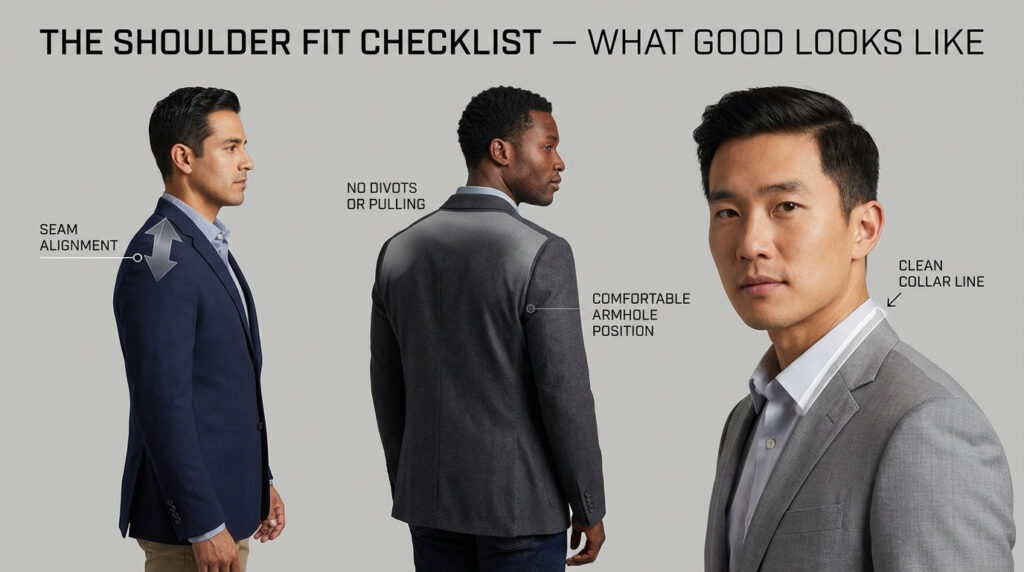
The shoulder fit checkpoint:
- Shoulder seam aligns with your natural shoulder edge
- No divots or pulling across the shoulder blades
- Collar hugs your neck without gaping
- Armholes feel comfortable when you move
- Fabric doesn’t bunch at the shoulder point
Some tailors can add or remove shoulder padding for $15–$25 per shoulder, but this only adjusts the shape slightly. It doesn’t narrow a too-wide shoulder or add width where you need it. True shoulder reconstruction exists, but it typically costs $150+ and requires dismantling most of the jacket. At that point, you’re better off finding a suit with correct shoulder fit from the start.
This rule applies whether you’re shopping for interview suits, wedding attire, or office wear. Get the shoulders right off the rack, then tailor everything else.
Men’s suit jacket alterations by type
Once you’ve confirmed the shoulders fit, these suit jacket alterations can transform an off-the-rack suit into something that looks custom-tailored. Each alteration changes specific aspects of fit and has different cost-to-value ratios.
Jacket sleeves: shorten and lengthen
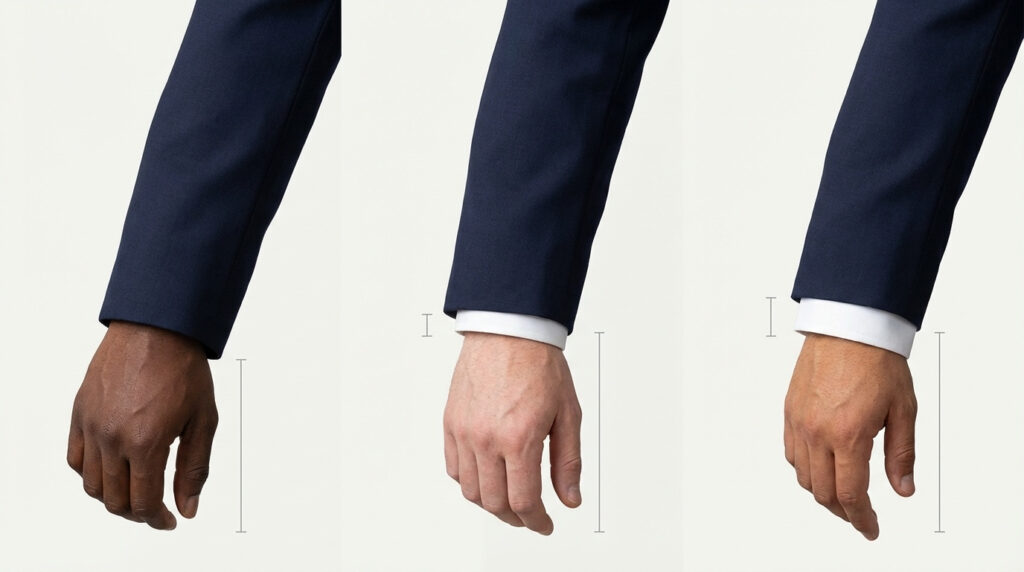
What it changes: Sleeve length so the proper amount of shirt cuff shows (about 1/4 to 1/2 inch)
Difficulty: Easy
Worth it: Almost always yes
Example pricing: $32 at in-house tailors / $42 at outside alteration shops
Jacket sleeve shortening is one of the most common and worthwhile suit alterations. Sleeves that are too long make you look like you borrowed dad’s suit. Too short, and you expose too much shirt cuff, throwing off the proportions.
Most tailors shorten sleeves from the shoulder seam, preserving any working buttonholes or decorative details at the cuff. Some high-end suits have functional buttonholes that open and close, which limits how much can be taken from the bottom. In those cases, shortening from the shoulder maintains the cuff design but costs slightly more due to complexity.
Lengthening sleeves is trickier and depends entirely on how much fabric is available in the seam allowance. Most jackets have 1–2 inches hidden, but that’s it. If you need more length than that, you can’t fix it.
Jacket sleeves: taper and new vent work
What it changes: Sleeve width through the forearm, plus reconstruction when working buttonholes exist
Difficulty: Moderate to complex
Worth it: Sometimes, if the jacket is otherwise excellent
Tapering jacket sleeves creates a slimmer, more modern fit through the arm. This alteration works well if you’ve got slim arms and the jacket sleeves feel billowy. Combined with shortening, it creates a much more refined look.
The complication comes with working buttonholes. If your suit has functional buttons that actually open at the cuff (common on higher-end suits), the tailor can’t shorten from the bottom without removing that detail. They’ll need to shorten from the shoulder and potentially reconstruct the vent at the cuff, which increases both time and cost.
Bottom line: if the suit is quality and fits well elsewhere, sleeve tapering can be worth it. If you’re fighting multiple fit issues, it’s probably not the right suit.
Jacket waist and sides: taking in the body
What it changes: How the jacket follows your torso shape, eliminating excess fabric
Difficulty: Moderate
Worth it: High-value alteration for most men
Example pricing: $35 in-house / $50 outside
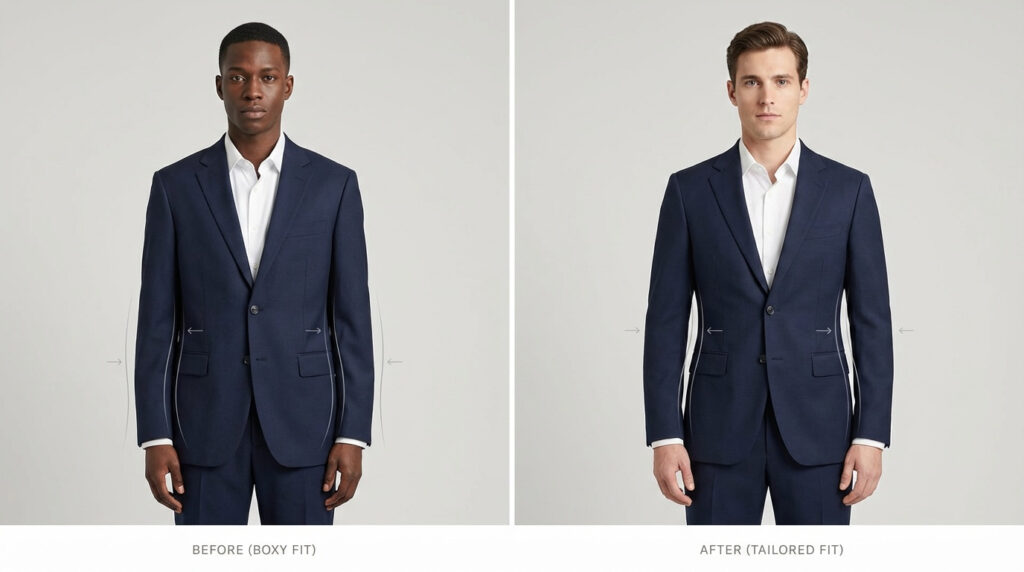
Taking in the jacket waist and sides transforms a boxy, off-the-rack fit into something that actually looks tailored. The tailor removes excess fabric from the side seams and sometimes the center back seam, creating a subtle taper that follows your natural shape.
This is one of the best suit jacket alterations you can do. It changes how the entire jacket looks without being obvious. You’ll notice the jacket no longer billows when you button it, and the overall silhouette looks sharper and more intentional.
Most jackets can be taken in 2–3 inches total without issues. Beyond that, you start running into pocket placement problems and proportion concerns. If a jacket needs more than 3 inches removed, it’s too big in the chest and shoulders, and you should size down.
Collar and neck: lower collar, shorten collar
What it changes: How the collar sits against your neck, eliminating gaps
Difficulty: Moderate
Worth it: Yes, if the collar gap bothers you and shoulders fit correctly
Example pricing: Lower collar $32/$42, shorten collar $52/$62
A collar that stands away from your neck looks sloppy and draws attention for the wrong reasons. This usually happens when there’s excess fabric in the upper back or when the collar construction doesn’t match your neck shape.
Lowering the collar removes a small amount of fabric from where the collar attaches to the jacket body, allowing it to hug your neck better. Shortening the collar adjusts the actual collar band length.
Here’s the catch: collar issues often signal shoulder fit problems. If the shoulders are too big, the collar will never sit right no matter what adjustments you make. Fix collar issues only when you’re confident the shoulders fit properly first.
Shoulders: padding vs. true shoulder reshaping
What it changes: Shoulder shape and structure (padding only, not width)
Difficulty: Adding padding is easy; reshaping structure is expert-level
Worth it: Rarely, unless it’s a minor padding adjustment
Example pricing: Add/remove padding $15/$25 per shoulder
Let’s be clear: changing padding is not the same as narrowing shoulder width or fixing shoulders that are too small. Padding adjustments can slightly round out or slim down the shoulder shape, but they don’t change the fundamental structure.
True shoulder reshaping requires taking apart the entire upper jacket, moving the sleeve attachment point, and reconstructing everything. It’s technically possible but costs $150+ and often results in a jacket that still doesn’t look quite right. The proportion issues that come with wrong shoulders extend throughout the jacket.
If you need real shoulder changes, return the suit and find one with correct shoulder fit. Shoulder padding adjustments only make sense for minor tweaks on an otherwise well-fitting jacket.
Jacket length: shortening the coat
What it changes: Overall jacket length from shoulder to hem
Difficulty: High risk
Worth it: Rarely, due to proportion and pocket placement issues
Shortening a suit jacket is possible but comes with significant risks. The jacket’s proportions are designed around its original length. When you shorten it, pockets move closer to the hem, vents may look stubby, and the overall balance can look off.
Most style guidelines say the jacket should cover your seat and end around the middle of your thumb when your arms hang naturally. If a jacket is slightly long, you might tolerate it. If it’s dramatically long, it’s the wrong size.
Tailors can typically remove up to 1 inch from the hem without major proportion issues. Beyond that, you’re gambling on whether the jacket will still look balanced. Given the cost and risk, shortening jacket length should be a last resort on an otherwise perfect suit.
Structural tweaks: vent, lapel, and armhole
What it changes: Advanced structural elements
Difficulty: Expert-level
Worth it: Conditional, usually for high-value suits only
These alterations fall into the “specialized” category. Closing a vent, shrinking a lapel, or deepening an armhole requires expertise and changes fundamental design elements of the jacket.
Deepening the armhole, for example, can improve mobility and create a sleeker fit, but it’s complex work that involves resetting the sleeve. Most off-the-rack suits won’t justify this level of alteration unless they’re high-quality garments worth several hundred dollars.
If you’re considering these alterations, get a consultation with an experienced tailor who specializes in suit reconstruction. They’ll tell you honestly whether the changes are feasible and worth the investment.
Men’s suit trouser alterations by type
Suit pants alterations are generally more straightforward than jacket work, and they deliver significant value. Most fit issues in trousers involve length, waist size, and leg taper, all of which tailors handle routinely.
Hem and bottoms: plain or cuff
What it changes: Pant length and how the fabric breaks over your shoes
Difficulty: Easy
Worth it: Essential for almost every suit
Example pricing: $18 in-house / $28 outside
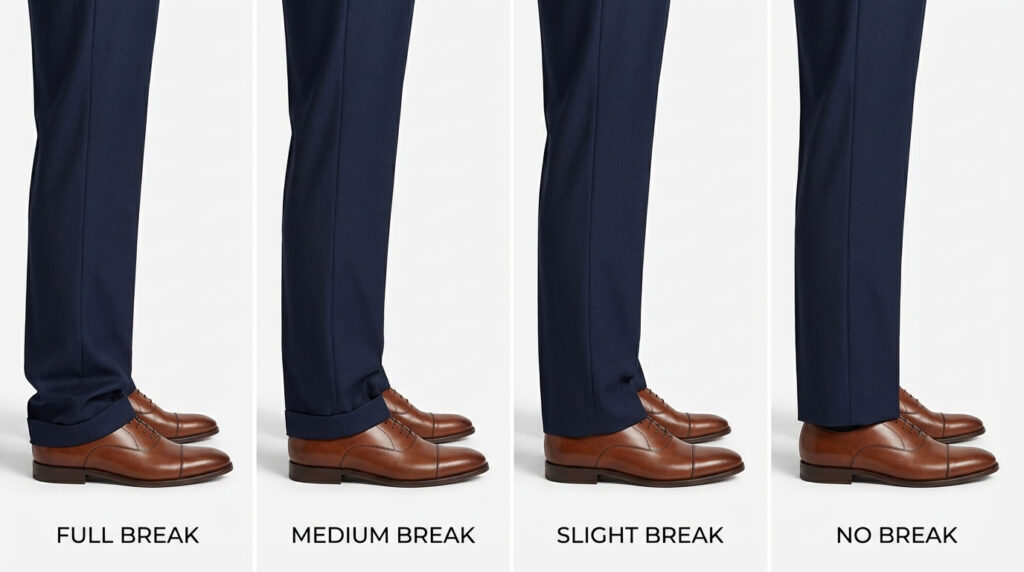
Suit pants hemming is the most common alteration, and for good reason. Off-the-rack pants are manufactured in standard inseam lengths, and very few men fit those standards perfectly. Getting the hem right changes your entire look.
The key decision is the break: how much fabric rests on your shoe. A full break means significant fabric bunching; a half break shows a slight fold; no break means the pant just grazes the shoe. Modern style leans toward a quarter to half break for a cleaner, more contemporary silhouette.
You can choose a plain hem (fabric folded and sewn) or a cuff (fabric folded over itself, creating a band at the bottom). Cuffs add weight to the pant leg and work well on wider-leg trousers. Plain hems look sleeker on slim or tapered pants.
Suit pants break adjustment goes hand-in-hand with hemming. Communicate your preferred break to your tailor, and wear the shoes you’ll actually wear with the suit. The difference between dress shoes and loafers affects the proper hem length.
Waist and seat: take in or let out
What it changes: How the pants fit around your waist and seat
Difficulty: Moderate
Worth it: High-value alteration
Example pricing: $25 in-house / $35 outside
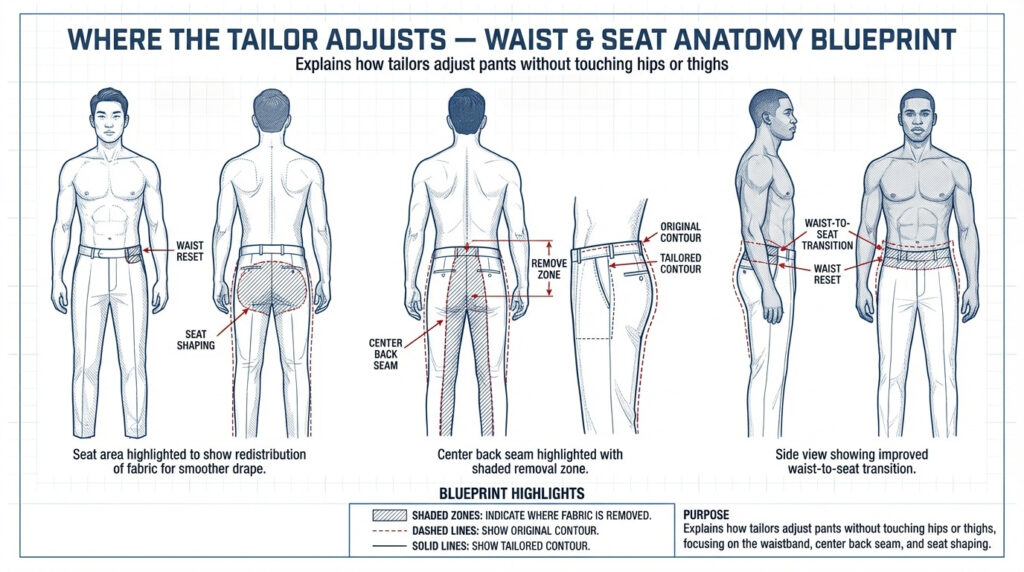
Taking in suit pants waist is one of the best alterations for fit and comfort. If your pants fit well through the hips and thighs but the waistband gaps in back, this fix eliminates that bunching and creates a clean line.
Tailors typically work through the center back seam, removing excess fabric and resetting the waistband. Most pants can be taken in 2–3 inches before you start affecting the pocket placement and overall proportion.
Letting out suit pants is more limited. You can only let out as much fabric as exists in the seam allowance, usually 1–2 inches maximum. If you need more than that, the pants are too small, and stretching them to fit will create visible seam lines and tension across the fabric.
When you’re trying to save a suit that’s close but not perfect, waist and seat alterations are worth doing. They’re affordable, effective, and don’t compromise the garment’s structure.
Waist, seat, and crotch: invasive reshaping
What it changes: More comprehensive fit through the entire upper pant
Difficulty: Complex
Worth it: Only if the suit is otherwise excellent
Example pricing: $35 in-house / $45 outside
This level of alteration goes beyond basic waist adjustment and involves reshaping the seat and crotch area for better overall fit. It’s more invasive and time-consuming than standard waist work.
The tradeoff: it costs more and still has limitations. If pants are significantly wrong in the rise, crotch, or seat, even extensive alterations may not create a comfortable fit. You’re better off finding pants with a better base fit.
Consider this alteration when you’ve found a high-quality suit that fits almost perfectly but needs fine-tuning in the upper pant area. Don’t use it to rescue pants with fundamental fit problems.
Crotch and rise adjustments
What it changes: The distance from the crotch seam to the waistband (rise)
Difficulty: Very limited by design
Worth it: Rarely feasible
Rise is one of those fit elements that’s nearly impossible to change meaningfully. Low-rise pants can’t become mid-rise or high-rise without reconstructing the entire pant. The crotch seam position is built into the pattern.
Some minor crotch adjustments can address specific comfort issues, like excess fabric bunching or slight pulling, but these are small tweaks rather than fundamental changes.
If the rise feels wrong when you try on the suit, that’s a dealbreaker. You can’t fix it affordably or effectively, so move on to a different pant style or brand that fits your body better.
Taper leg and extreme taper
What it changes: Leg width from knee to hem, creating a slimmer silhouette
Difficulty: Moderate
Worth it: Often yes, for a modern fit
Example pricing: Taper $32/$42, extreme taper varies
Adjusting suit pants thighs and tapering the leg creates a contemporary, tailored look. If you’ve got slim legs and your suit pants feel baggy from the knee down, tapering solves that problem.
Standard tapering narrows the leg while maintaining a balanced proportion. Extreme tapering creates a very slim silhouette, popular in fashion-forward styles but potentially too aggressive for conservative office environments.
The limitation: you can only taper as much as the existing fabric allows. If pants are very wide to begin with, tapering them dramatically may create weird proportions or put too much strain on the side seams. Most tailors will tell you if the taper you want isn’t feasible.
Tapering works best when you start with a decent base fit and want to refine the silhouette. It doesn’t fix pants that are fundamentally too large.
Major surgery: re-cut pant and remove pleats
What it changes: Complete reconstruction of the pant or removal of pleated front
Difficulty: Expert-level
Worth it: Almost never, due to cost
Example pricing: Re-cut pant $100/$125, remove pleats $90/$115
These alterations are expensive enough that they serve as proof you should return the suit and find a better base fit.
Re-cutting pants means taking them apart and reconstructing them in a smaller size or different shape. At $100+, you’re approaching the cost of buying new pants entirely. Unless you’re dealing with a very expensive suit where the fabric alone justifies the cost, re-cutting doesn’t make financial sense.
Removing pleats involves opening the front of the pant, eliminating the pleated fabric, and reconstructing the waistband and zipper area. It’s complex, costly, and still won’t fix underlying fit issues if the pants are too big.
If a tailor suggests these alterations, seriously consider whether you should keep the suit at all.
Hardware and finishing: zipper, belt loops, suspender buttons
What it changes: Functional hardware and finishing details
Difficulty: Easy to moderate
Worth it: When needed for function
These are straightforward fixes for specific issues. Replacing a broken zipper, adding or removing belt loops, or installing suspender buttons are all reasonable alterations when you want to customize or repair your pants.
The cost is usually modest, and the work is routine for most tailors. If you prefer suspenders over a belt, adding interior suspender buttons is a worthwhile customization that improves comfort and function.
Rush fees and planning reality
What it changes: How quickly your alterations are completed
Rush fee within 3 days: Coats $15, slacks $10
Now we get to how long do suit alterations take. Standard turnaround at most tailors runs 7–10 business days. If you need alterations faster, expect to pay rush fees.
Rush work within three days typically adds $15 for jackets and $10 for pants. Same-day or next-day alterations may cost even more and aren’t always available, depending on the shop’s workload.
The better strategy: plan ahead. If you’re buying a suit for an interview or wedding, allow at least two weeks for alterations. This gives you time for a fitting, adjustments, and a final check to ensure everything fits correctly.
Rushing alterations increases cost and reduces the opportunity to get things right. Good tailors need time to do quality work.
How much can trouser waists be altered?
Trouser waist alterations are best for fine-tuning fit, not changing sizes. Most tailors adjust at the center back seam; how far you can go depends on seam allowance, pocket placement, and keeping the seat and rise balanced so the pants still hang cleanly (no twisting or diagonal pull).
| Rule of thumb (waist) | Typical max |
|---|---|
| Taking in suit pants waist | Up to 2 in total |
| Letting out suit pants | Up to 1 in total |
Stop signs: pockets flare, back crotch pulls, seat looks strained, or the waistband must shift off-center. In those cases, size up or down, then handle suit pants hemming and suit pants break adjustment separately. Unlike most suit jacket alterations, a big waist change can quickly throw off the whole trouser line.
- How much seam allowance is available to let out?
- Will pocket placement look odd after the change?
- Will the seat and rise stay balanced when I sit?
- Do you recommend a different size instead?
Pricing snapshot: men’s suit alterations
Here’s a quick reference for common suit alteration costs. These examples reflect typical pricing, with the first number representing in-house tailor costs and the second representing outside alteration shops.
Common men’s suit alteration pricing examples:
| Alteration | In-house price | Outside price |
|---|---|---|
| Men’s suit jacket sleeves shorten/lengthen | $32 | $42 |
| Men’s suit jacket sides (take in waist) | $35 | $50 |
| Men’s suit pants hem (plain or cuff) | $18 | $28 |
| Men’s suit pants waist-seat adjustment | $25 | $35 |
| Men’s suit pants taper | $32 | $42 |
| Men’s suit pants re-cut | $100 | $125 |
| Lower/adjust collar | $32 | $42 |
| Shoulder padding adjustment (each) | $15 | $25 |
| Remove pleats from pants | $90 | $115 |
Important caveat: Prices vary significantly by tailor, location, and garment construction. Designer suits or those with complex details like working buttonholes, hand-sewn elements, or unusual fabrics will cost more to alter. In-house tailors at the store where you purchased the suit often offer lower pricing than independent alteration shops. Always get a quote before authorizing work.
How long does it take to get a suit tailored?
Most off-the-rack men’s suit alterations land in a one to two week window. Quick wins like suit pants hemming or a suit pants break adjustment can be faster, while multiple suit jacket alterations or any work that changes lining, vents, or sleeve details tends to take longer. Expect 1 fitting for simple jobs and 2 fittings when you combine jacket and trouser work (for example, taking in suit pants waist plus sleeve and jacket shaping).
Your timeline can shift if the shop is busy (wedding season and holidays), you are tailoring multiple garments, or the suit has special construction. Letting out suit pants is also variable because the tailor has to confirm seam allowance before approving the change. Note: women’s suiting and casual jackets often use different construction, so alteration timelines can differ.
| Alteration scope | Typical timeline | Fittings |
|---|---|---|
| Simple | 3–7 business days | 1 |
| Standard suit (jacket + pants) | 7–10 business days | 1–2 |
| Complex or special construction | 10–15 business days | 2+ |
| Rush service (when offered) | 1–3 business days | Usually 1 |
- Book your first fitting 2–3 weeks before your event.
- Schedule pickup 5–7 days before, in case a second fitting is needed.
- Bring your event shoes and shirt to every fitting.
- If you need a rush, confirm availability and fees before leaving the suit.
What alterations can be made to a ready-to-wear jacket?
Most suit jacket alterations on an off-the-rack coat are “surface” adjustments that refine shape without moving the jacket’s core framework. A tailor can usually neaten the body (light suppression), tidy a small collar gap, and fine-tune sleeve length or width. The hard limits show up where structure lives: shoulders, chest canvas, armholes, and overall balance. Once you start relocating sleeve attachment points or reworking the chest, you are paying for risky reconstruction that rarely looks like true made-to-measure. If your jacket feels wrong in the upper body, use Fit Fundamentals to confirm sizing before you spend on fixes.
- Can: minor waist shaping, small collar tweak, modest sleeve adjust
- Can’t (worth it): meaningful shoulder width changes, big chest reshaping, raising armholes, major balance or length corrections
Typical ranges and timing:
| Item | Typical range | Timeline |
|---|---|---|
| Jacket alterations (most) | $30–$150+ | 5–10 business days |
| Reconstruction work | $150–$300+ | 2–4 weeks |
- Return it instead if the chest pulls or caves, the armholes bind, or the jacket looks unbalanced when buttoned. Recheck sizing with Fit Fundamentals.
- If you are also relying on suit pants hemming, suit pants break adjustment, taking in suit pants waist, or letting out suit pants just to make the set wearable, size up or swap styles.
Note: women’s suiting and casual jackets often use different construction, so alteration limits can change.
Should you tailor that suit or pass?
Not every fit issue is worth fixing. Some suits just aren’t meant to be. Here’s how to figure out whether alterations make sense, or if you should keep looking for something better off the rack.
Tailor it if:
- The shoulders hit right at your natural shoulder point
- The chest feels comfortable when you button it, with enough room to actually move
- You’re only looking at sleeve adjustments, waist tweaks, and hemming the pants
- The total cost for alterations stays under 20% of what you paid for the suit
- You’re just fine-tuning length and fit, not trying to rebuild the whole thing
- The fabric quality and how it’s made actually justify spending more on it
Skip it if:
- Shoulders hang past where they should, or they’re pulling tight up top
- The chest either caves in or strains when you button it
- You’d need to let anything out by more than 2 inches
- You’re looking at multiple big fixes (jacket length, shoulders, major waist reconstruction)
- Alterations are going to run you 30% or more of what the suit costs
- Your tailor looks uncertain or tells you straight up that it might not work
- The pants rise or crotch just feels fundamentally off
Can you fix a suit that’s too big?
Depends on where the extra fabric is:
- Too long in the sleeves and pants? Yeah, easy fixes.
- Too loose in the waist and sides by 2 or 3 inches? Sure, that’s doable.
- Too big in the shoulders and chest? Don’t bother.
- Too big everywhere, needing the jacket shortened, sleeves adjusted, waist taken in, and pants rebuilt? Walk away. The investment isn’t worth it.
The whole point is finding something that’s pretty close to right from the start. Then you use alterations to dial in the details. If you’re battling the suit’s basic size and structure, you’re trying to save something that can’t really be saved.
When you’re not sure, just ask your tailor directly: “Is this worth fixing, or should I find something else?” A good tailor will be honest with you. They’d rather work on a suit that has good bones than struggle with something that’s wrong from the jump.
Frequently asked questions about men’s suit alterations
Next steps
If your suit is close, you’re in the sweet spot: off-the-rack plus smart men’s suit alterations can look made-to-measure. Start by revisiting Fit Fundamentals, then book a fitting so you can prioritize the biggest visual wins first, like suit jacket alterations for shape and sleeve length, plus suit pants hemming and a clean suit pants break adjustment.
At the appointment, aim for clarity, not perfection on day one. This guide focuses on suits, not casual jackets.
- Bring the dress shoes and shirt you’ll wear most, plus your belt or suspenders.
- Ask what’s “easy value” vs. “high risk,” especially around shoulders and jacket length.
- Confirm limits: taking in suit pants waist is usually straightforward; letting out suit pants depends on seam allowance.
- Request a quick try-on plan: pin first, adjust second, final check last.
| Typical price ranges | Pants hem $18–$28; pant waist-seat $25–$35; jacket sleeves $32–$42; jacket sides $35–$50 |
|---|---|
| Timing to plan for | Most jobs: 7–10 business days; allow extra time if multiple fixes are needed |
What men’s suit alterations can a tailor do (and what can’t be fixed)?
A tailor can adjust suit jacket sleeves, take in the waist and sides, hem pants, taper legs, and alter waistbands on trousers. These alterations refine fit without changing the garment’s fundamental structure. Tailors typically can’t fix shoulders that are too wide or narrow, chest fit that’s significantly off, or pants rise issues. Letting out garments is limited to the existing seam allowance, usually 1–2 inches maximum. Structural elements like shoulder width, armhole placement, and jacket length are difficult or impractical to change on most off-the-rack suits.
Can a men’s suit that’s too big be altered to fit properly?
Yes, if the suit is too big in specific areas like sleeve length, waist, or pant length, alterations can create a proper fit. A tailor can shorten sleeves, take in the jacket sides, hem pants, and adjust the trouser waist effectively. However, if the suit is too big in the shoulders or chest, alterations won’t work. Shoulders are the foundation of jacket fit and can’t be meaningfully narrowed on most suits. If you need more than 3 inches removed from the waist or body, the suit is too large overall and should be returned for a smaller size.
Can a tailor alter men’s suit shoulders?
Tailors can make minor adjustments to shoulder padding, adding or removing it to change the shoulder shape slightly, typically for $15–$25 per shoulder. However, changing the actual shoulder width or structure requires expert-level reconstruction that costs $150+ and often yields poor results. Shoulder work involves taking apart the upper jacket, moving sleeve attachment points, and reassembling everything. The cost and risk make it impractical for most off-the-rack suits. If shoulders don’t fit correctly when you try on the suit, you should find a different size or brand rather than attempt alterations.
How much do men’s suit alterations cost?
Common alterations range from $18–$50 for most standard adjustments. Suit pants hemming typically costs $18–$28, jacket sleeve shortening runs $32–$42, and taking in the jacket waist costs $35–$50. Pant waist adjustments are $25–$35, and tapering legs costs $32–$42. Complex alterations like removing pleats ($90–$115) or re-cutting pants ($100–$125) cost significantly more. Prices vary by location, tailor, and garment complexity. Designer suits or those with working buttonholes and hand-sewn details will cost more to alter than basic off-the-rack suits.
How long do men’s suit alterations take?
Standard suit alterations take 7–10 business days at most tailors. Simple alterations like hemming pants or shortening sleeves may be ready in 5–7 days, while complex work involving multiple adjustments can take up to two weeks. Rush services are available for an additional fee, with three-day rush typically adding $10–$15 per garment. Same-day or next-day alterations may be possible but cost more and aren’t always available depending on the shop’s workload. For important events like interviews or weddings, plan to purchase your suit at least two weeks in advance to allow proper time for alterations and a final fitting.
How much does it cost to hem men’s suit pants?
Hemming men’s suit pants costs between $18–$28 at most tailors. In-house tailors at the store where you purchased the suit often charge less (around $18) compared to independent alteration shops (around $28). The price covers a standard plain hem or cuff hem, which adjusts the pant length to create the proper break over your shoes. If you want a cuffed hem on pants that didn’t originally have one, the cost may be slightly higher. Hemming suit pants is one of the most cost-effective alterations and essential for proper fit and appearance.